Building Stronger Apache Communities Together
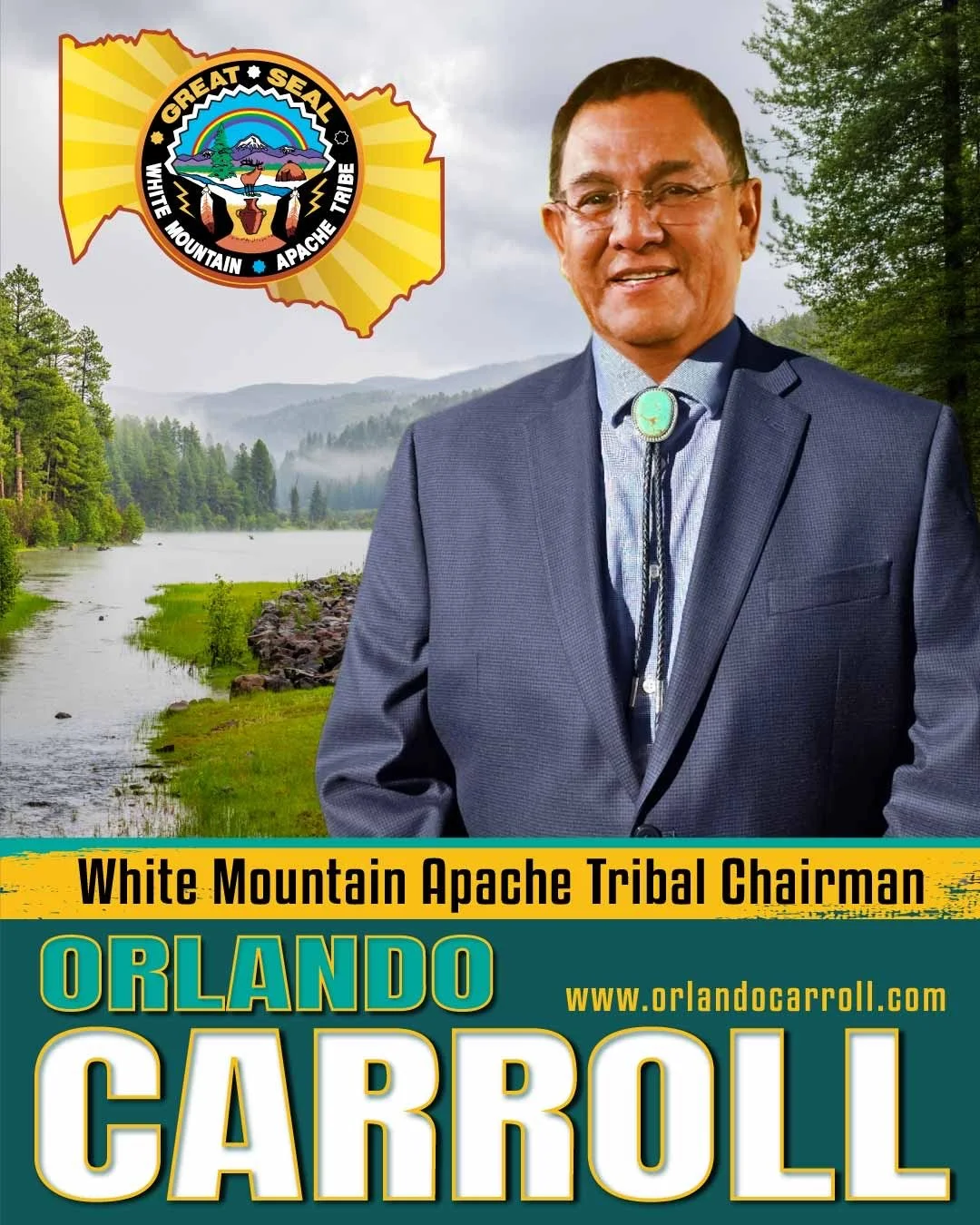
A Lifetime of Service to Our Land, Our People, and Our Future
For more than 30 years, Orlando Carroll has dedicated his life to protecting the land, waters, wildlife, and homelands of the White Mountain Apache Tribe. His work in land stewardship, conservation, and community service reflects a deep commitment to the people and the future of the People.
Now serving as WMAT Chairman, Orlando brings that same dedication to leadership guided by the values of the Ndee people and a clear understanding of both the challenges we face and the path forward.
He believes every Apache family deserves safety, opportunity, respect, and a government that listens. As WMAT Chairman, Orlando is committed to putting our people first, restoring trust, and rebuilding communities so that our children, elders, and future generations can thrive.
Thursday, September 24, 2026
A Message From Chairman Orlando Carroll
Working Together Through Accountability and Open Communication
My responsibility as Chairman is to serve the White Mountain Apache people, uphold our laws and policies, and ensure that our Tribal government operates responsibly and effectively. I understand that changes in how we conduct business can raise questions, and I welcome the opportunity to provide clarification.
Recently, concerns have been raised regarding employee dress standards, overtime approval and access to the Chairman's Office. I want our people to understand the purpose behind these procedures.
Employee Policies and Accountability
The recent memoranda regarding professional attire and overtime address requirements already established in the Tribe's Personnel Policies and Procedures Manual. Section I(A), pursuant to Tribal Council Resolution 11-2005-344, assigns the Chairman overall responsibility for implementing these policies, while Human Resources administers them.
Our responsibility is to ensure that existing policies are understood and applied consistently. Department heads and supervisors have important responsibilities, including approving overtime in accordance with Tribal policy. We will continue working with Human Resources and the appropriate officials to clarify these procedures and ensure that employees receive consistent guidance.
Access to the Chairman's Office
Our office remains open to the people we serve. We have introduced forms to document community concerns, coordinate meeting requests and ensure that every concern receives appropriate follow-up.
These forms are not intended to create barriers between the Chairman and our people. They help my staff maintain accountability by documenting concerns, referrals, appointments and actions taken. Many requests can be addressed directly by the appropriate departments, allowing us to resolve issues more efficiently.
My schedule includes meetings with community members, department directors, Tribal Council, other governments and organizations working on behalf of our Tribe. Our office is committed to making the best use of that time while ensuring that community concerns receive attention.
Moving Forward Together
I recognize that our employees and families face real challenges, including the rising cost of living and the need for better wages. These concerns deserve our attention as we work toward greater financial stability and improved services.
I also recognize that questions and differences of opinion are part of government. I remain committed to working with the Vice Chairman, Tribal Council, department directors and employees to address these matters through open communication and our established governmental processes.
My administration will continue focusing on responsible management of Tribal resources, accountability across departments, improved public services and greater access to Tribal government.
I encourage our people to ask questions, bring forward their concerns and remain engaged. We will continue providing information about the work of this administration and the decisions affecting our Tribe.
We have important work ahead of us, and I remain committed to serving the White Mountain Apache people with respect, accountability and dedication.
Orlando Carroll
Chairman, White Mountain Apache Tribe
CHAIRMAN'S OFFICE · COMMUNITY INFORMATION
Your Concerns Matter. Here's How We Keep Track.
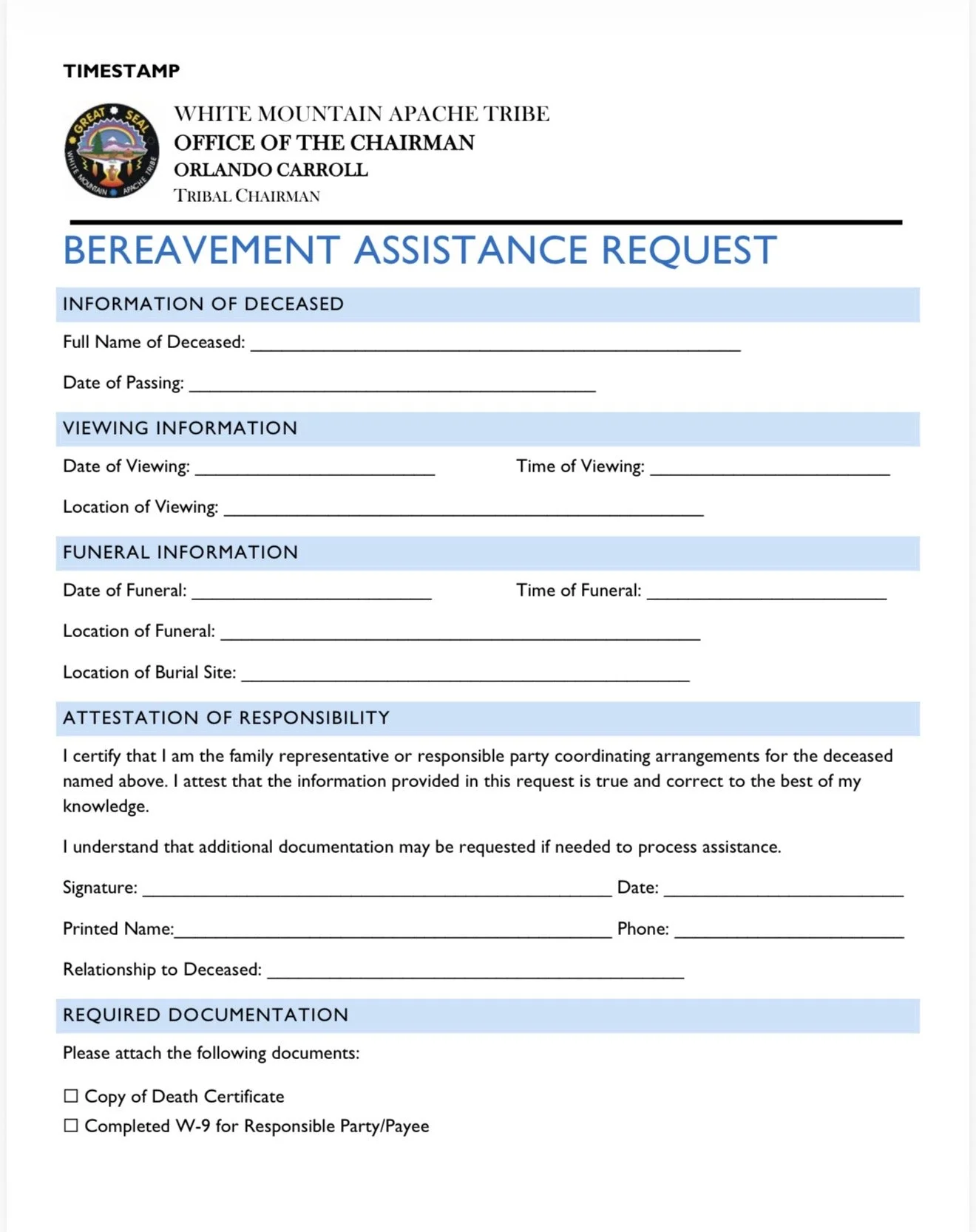
The Chairman's Office receives requests and concerns from community members every day. To help us serve our people more effectively, we have introduced forms to document concerns, coordinate appointments and track the actions taken.
These forms are not intended to prevent anyone from seeing the Chairman. They help us ensure that requests are documented, directed to the appropriate staff or department, and followed up on.
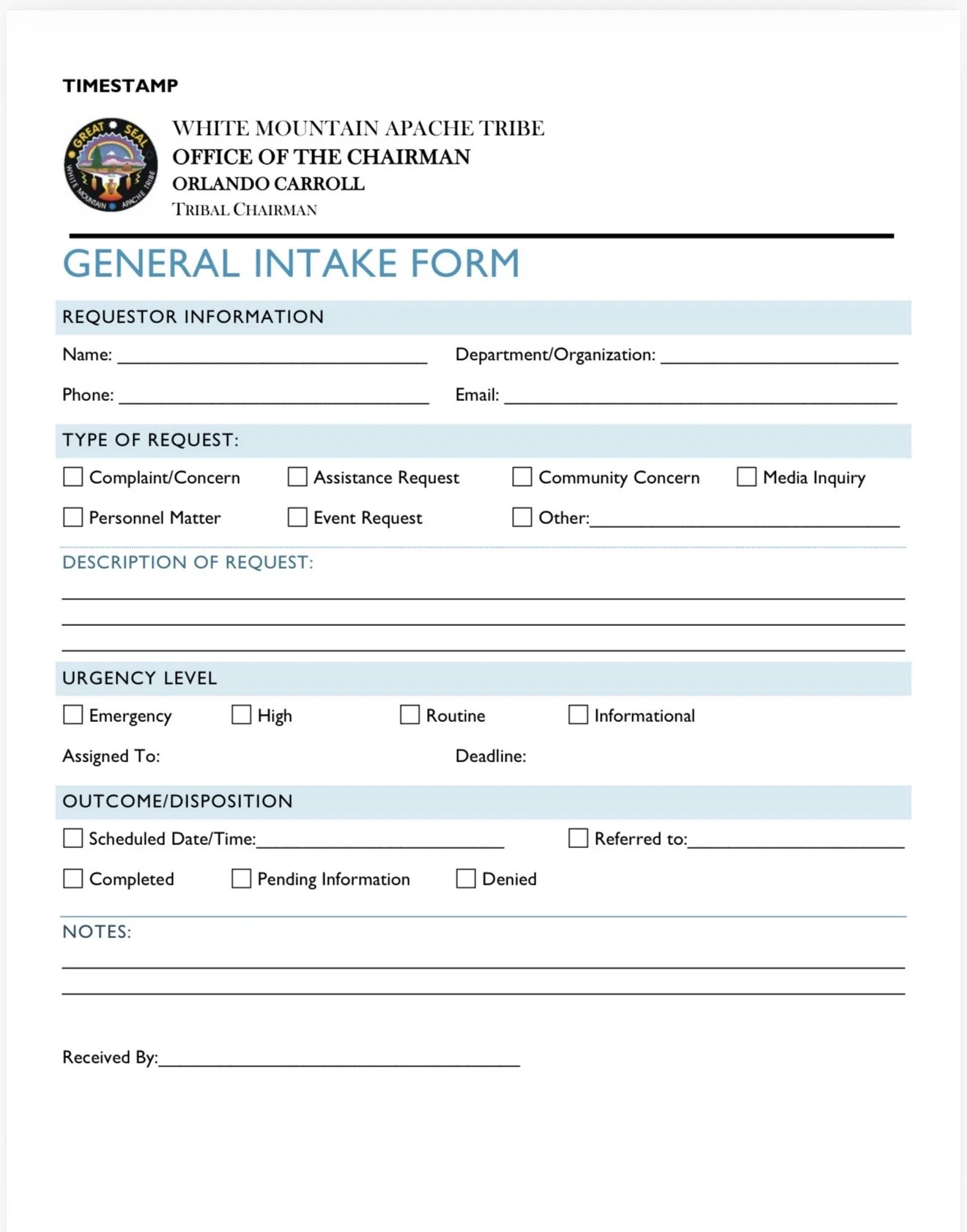
Each concern form includes a section where our staff can document the action taken, whether the matter was referred to another department, resolved or scheduled for further discussion.
We are sharing our forms so our people can see how this process works and understand how we are improving accountability within the Chairman's Office.
Our goal is to make Tribal government more accessible, responsive and accountable to the people we serve.
Bereavement Request: To request assistance from the Chairman’s Office following the loss of a loved one.
General Intake: To document community concerns, questions or requests and ensure appropriate follow-up.
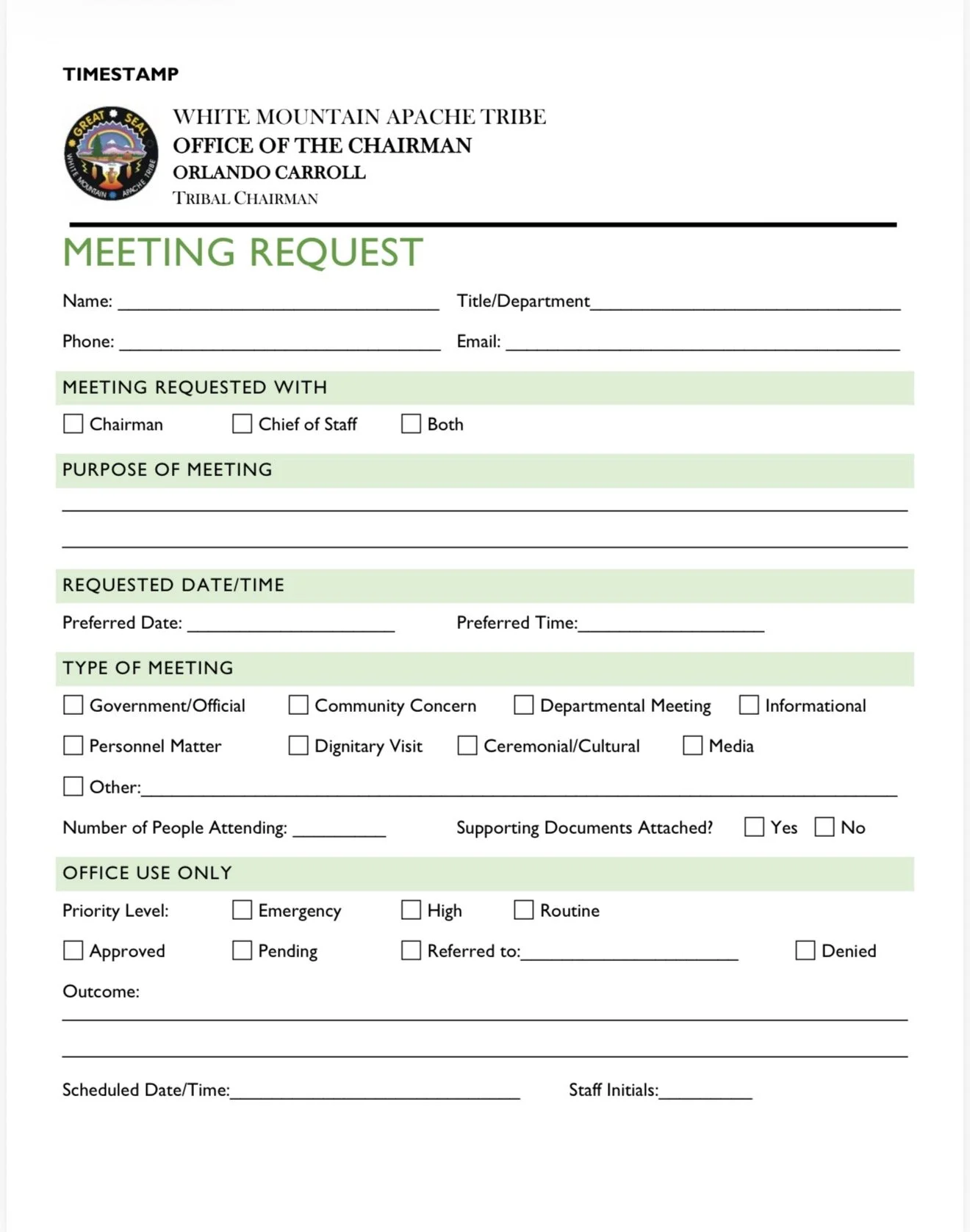
Meeting Request: To request and coordinate an appointment with the Chairman.
A Message About Meeting with the Chairman
Chairman Carroll’s schedule is regularly filled with meetings, community engagements and responsibilities on behalf of the Tribe. While he makes every effort to meet with community members, immediate access may not always be possible, particularly when he is already in a meeting with someone else. We kindly ask for your patience and understanding, as every person and every meeting is important to the Chairman. Our office uses meeting request forms to help coordinate appointments, manage his schedule and ensure that everyone receives the time and attention their concerns deserve.
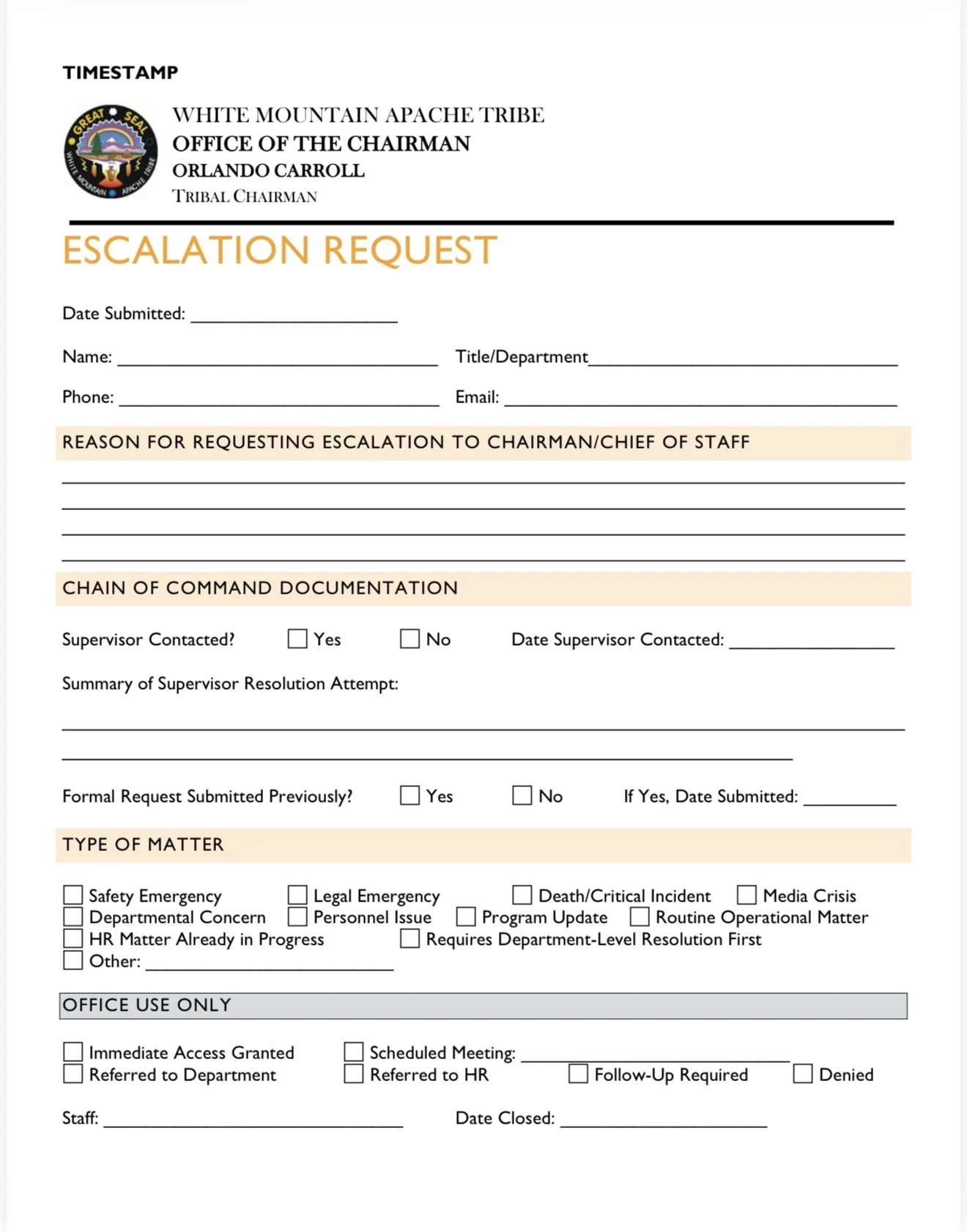
Escalation Request: To bring unresolved concerns that have already gone through the appropriate department or chain of command to the Chairman’s attention.
Departmental Accountability and Addressing Concerns
Chairman Carroll believes in empowering Tribal departments and directors to carry out their responsibilities and resolve issues at the lowest level possible. His approach is to allow departments to manage their daily operations, make decisions within their authority and remain accountable for the services they provide. This is what it means to follow the chain of command.
The Chairman does not expect every concern to come directly to his office when it can be addressed by the appropriate department, supervisor or Human Resources. However, we recognize that some concerns may remain unresolved even after going through the proper channels. For these situations, we have established an Escalation Request Form to ensure that concerns requiring additional attention are documented and appropriately reviewed.
The Chairman's role is to provide leadership, oversight and accountability while allowing departments to fulfill their responsibilities. This approach strengthens departmental leadership, encourages timely resolution of concerns and allows the Chairman to focus on matters requiring his direct attention.
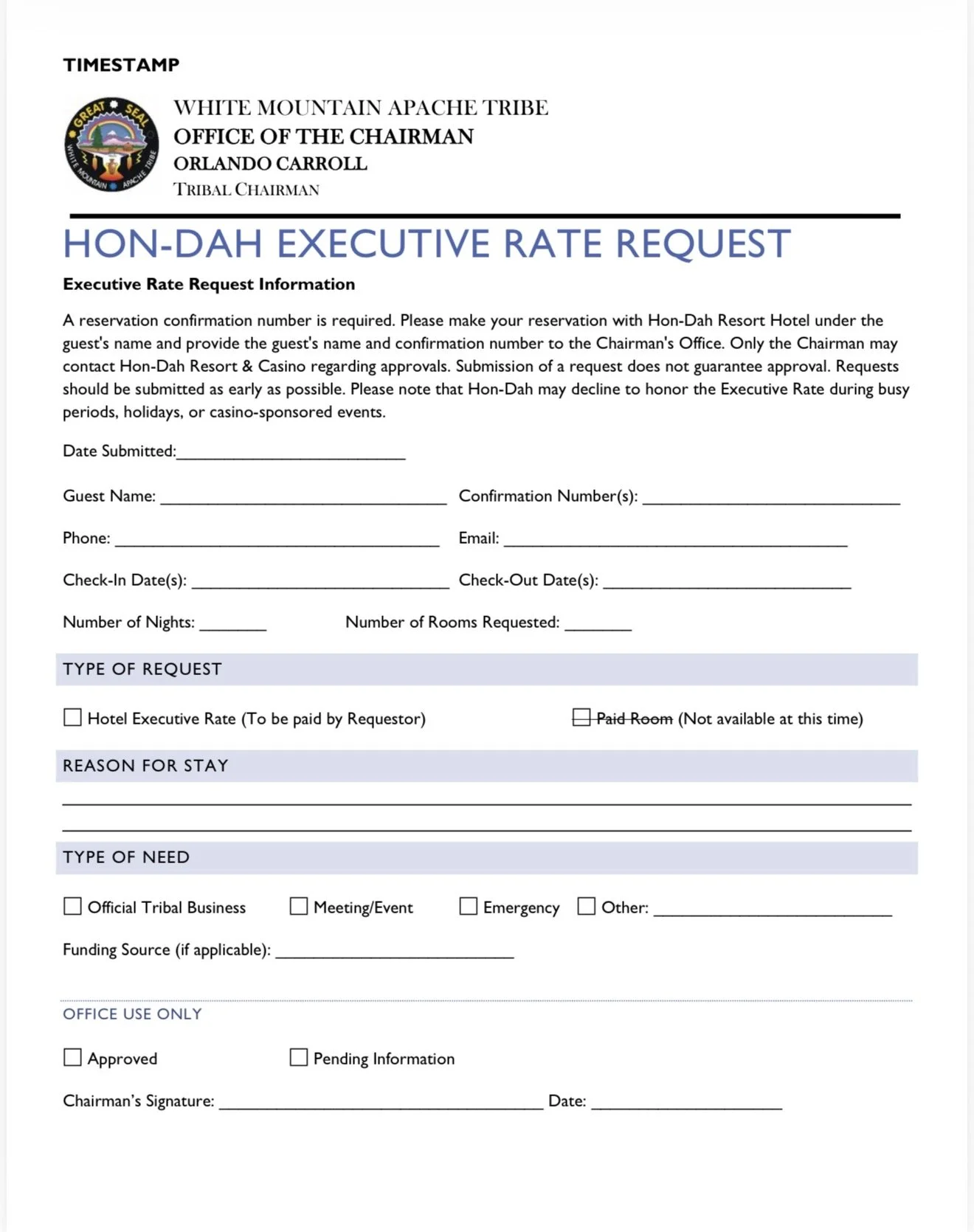
Hon-Dah Executive Rate Request: To request authorization for the executive lodging rate at Hon-Dah Resort.
Your Voice Can Help Create Change
We know our community has concerns, and we want to hear them. Social media can bring attention to an issue, but if you would like the Office of the Chairman to look into something, please also submit the information directly to our office.
When sharing a concern, please tell us what happened, the date and time, where it happened, who was involved, and who you have already spoken with. Include any documents, messages, photos, or other information that may help.
How to submit a concern:
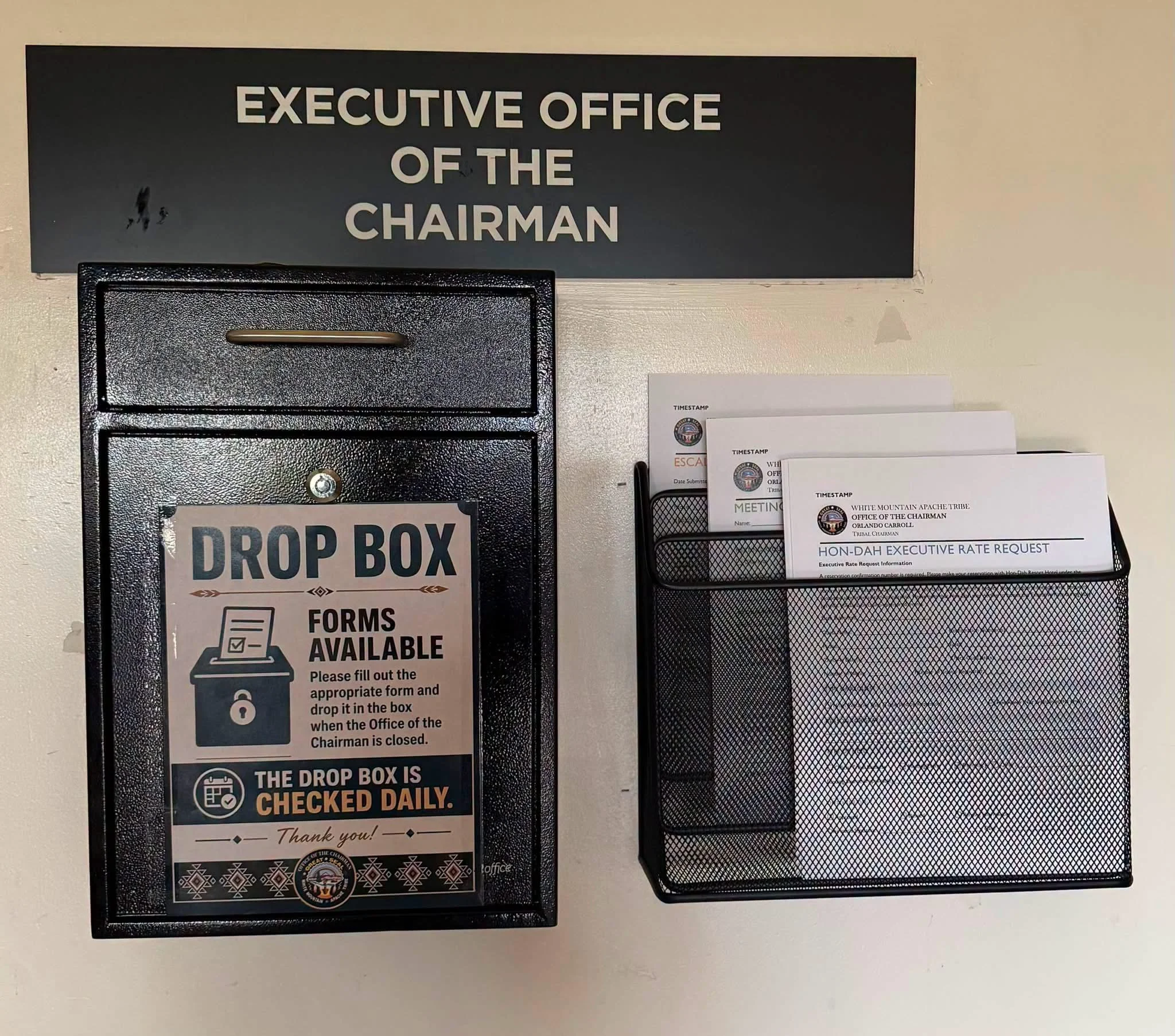
Stop by the Office of the Chairman and complete a General Intake Form. If the office is closed, forms are available at our drop box and completed forms can be placed inside. The drop box is located outside the Office of the Chairman, and is checked daily.
Having the details gives us a place to start. It allows our staff to ask the right questions, contact the appropriate people, follow up, and determine what can be done.
Our community knows where improvements are needed. Help us turn concerns into information we can act on and work together toward meaningful change.
Ft. Apache Scout Article, 9/14/2026
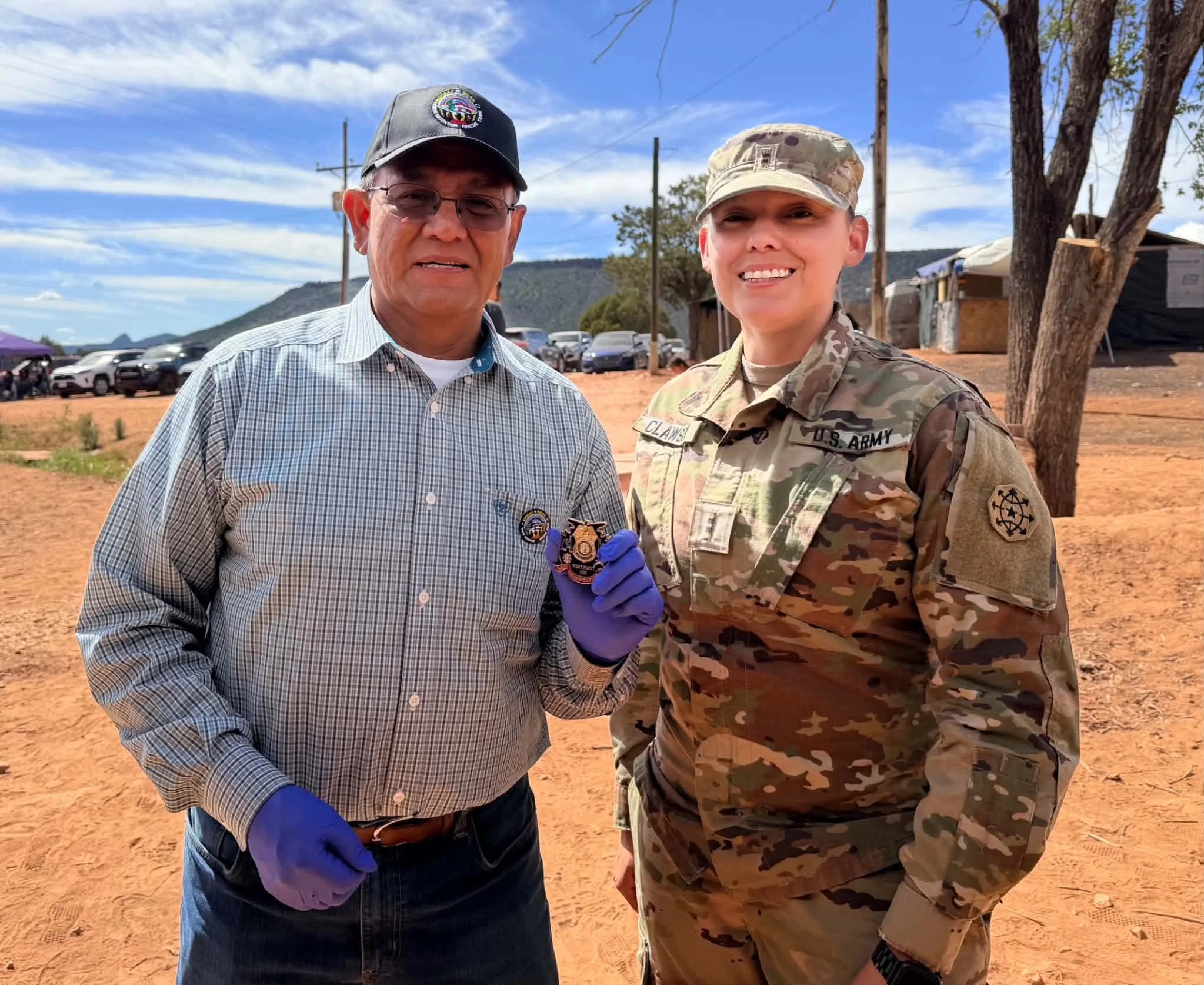
Chairman Carroll was honored to receive an office coin from Tribal member Chief Warrant Officer 2 Angela Clawson, U.S. Army, West Point Criminal Investigation Division. Clawson presented the coin as a gesture of respect and appreciation for the Chairman’s servant leadership, including providing free meals to the community during the Tribal Fair. Chairman Carroll thanks CW2 Clawson for this meaningful recognition and for her service.
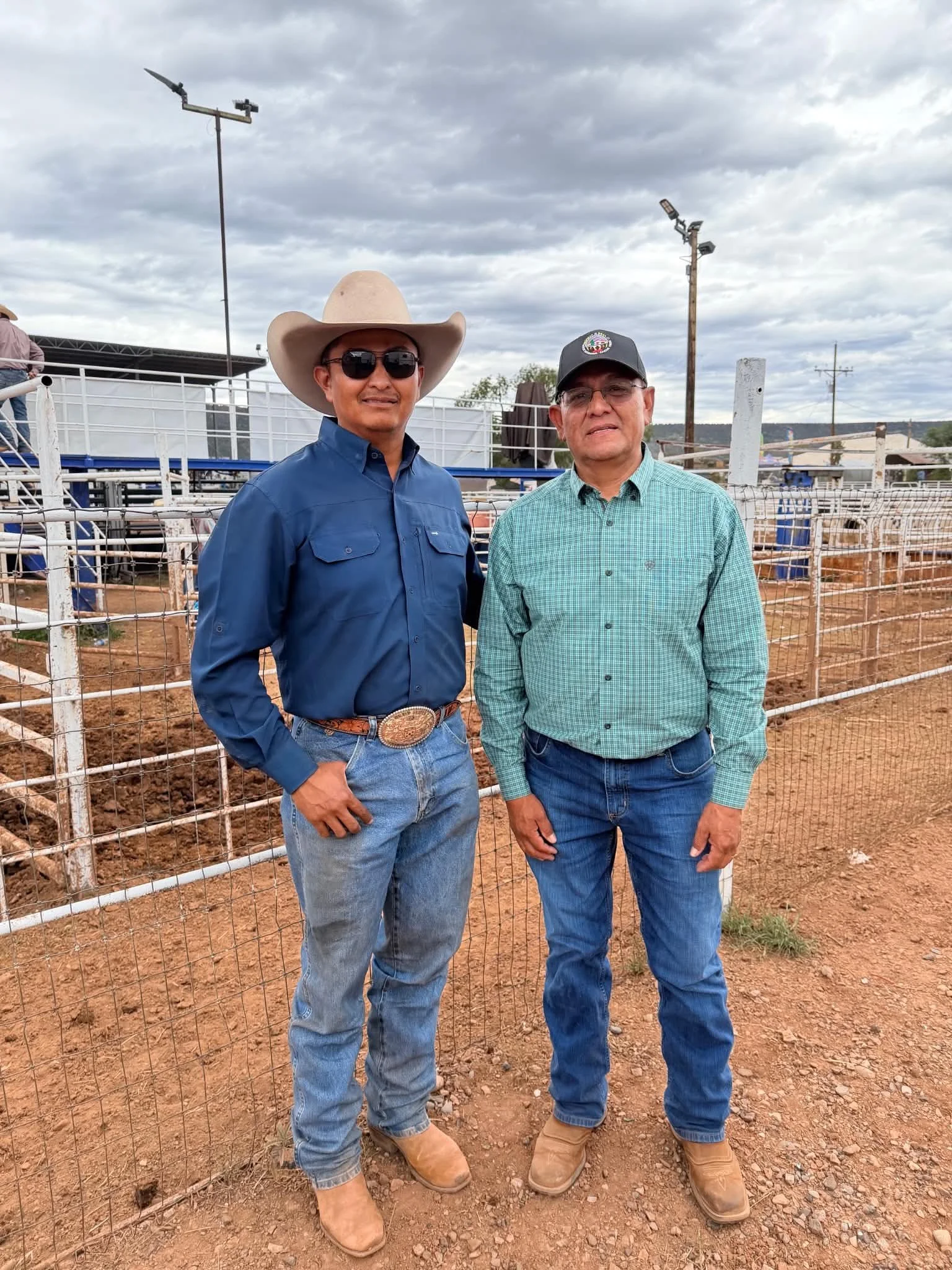
Chairman Carroll with 2015 PRCA World Champion Header Aaron Tsinigine, from Tuba City, at the 99th Annual WMAT Fair & Rodeo
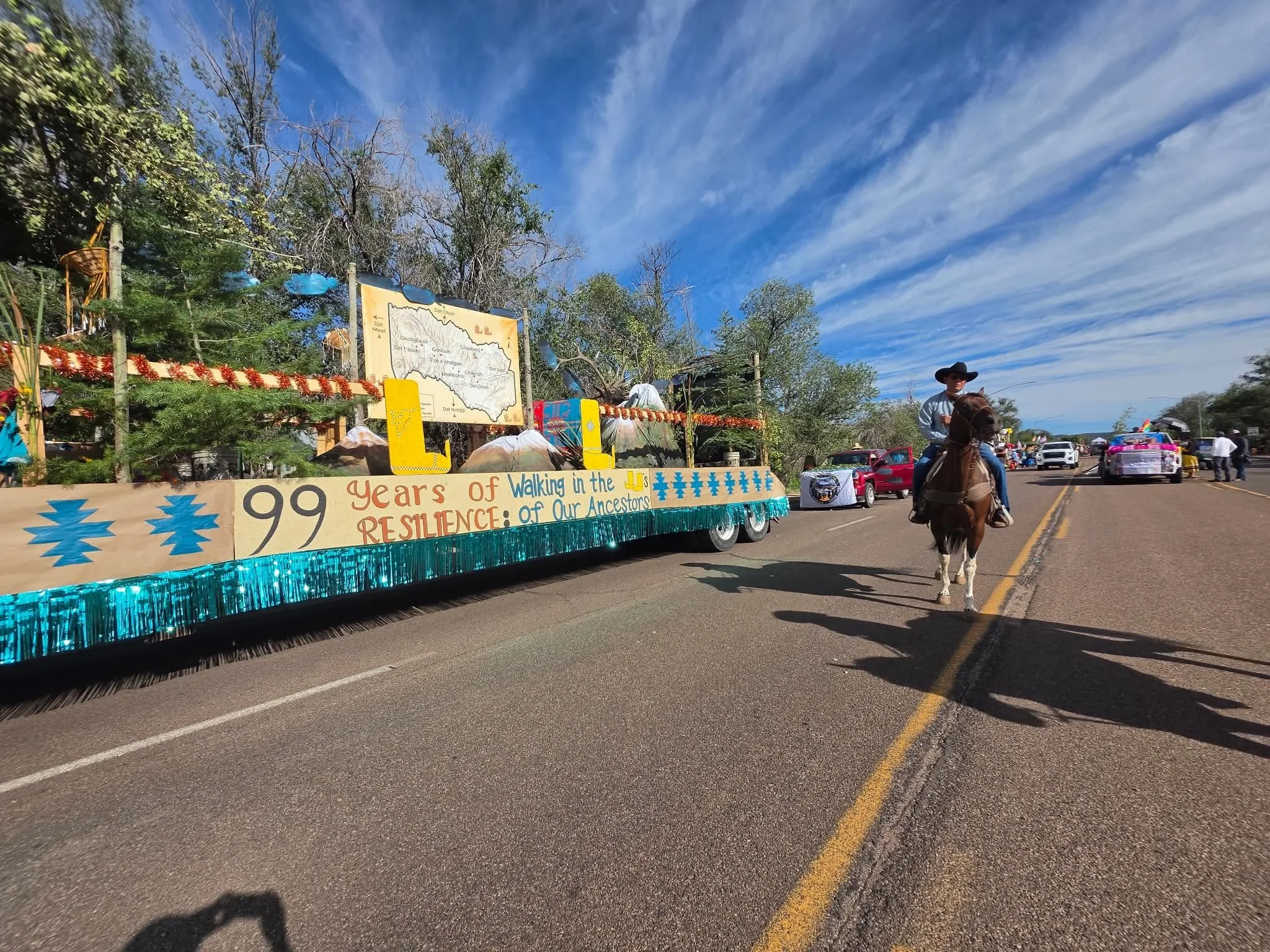
Chairman Carroll rode a horse through the parade this year, followed by his float that featured a map of the Fort Apache reservation with the traditional Apache place names, to help us remember 99 Years of Resilience: Walking in the Footsteps of Our Ancestors. The float also included mountains, trees, moccasins, and elders who have supported Chairman Carroll on his journey.
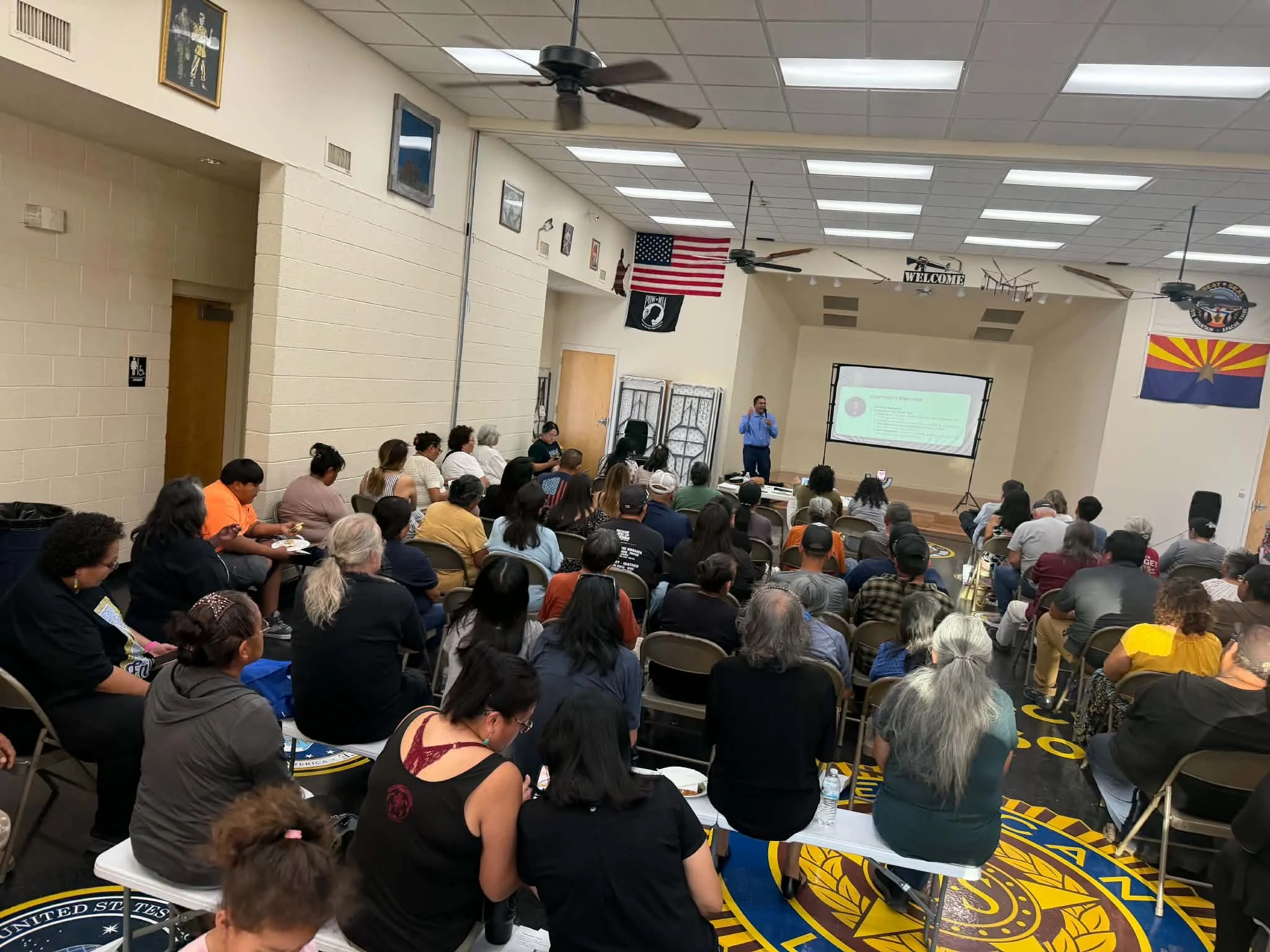
Chairman Carroll addressing tribal members at his first Town Hall Meeting.
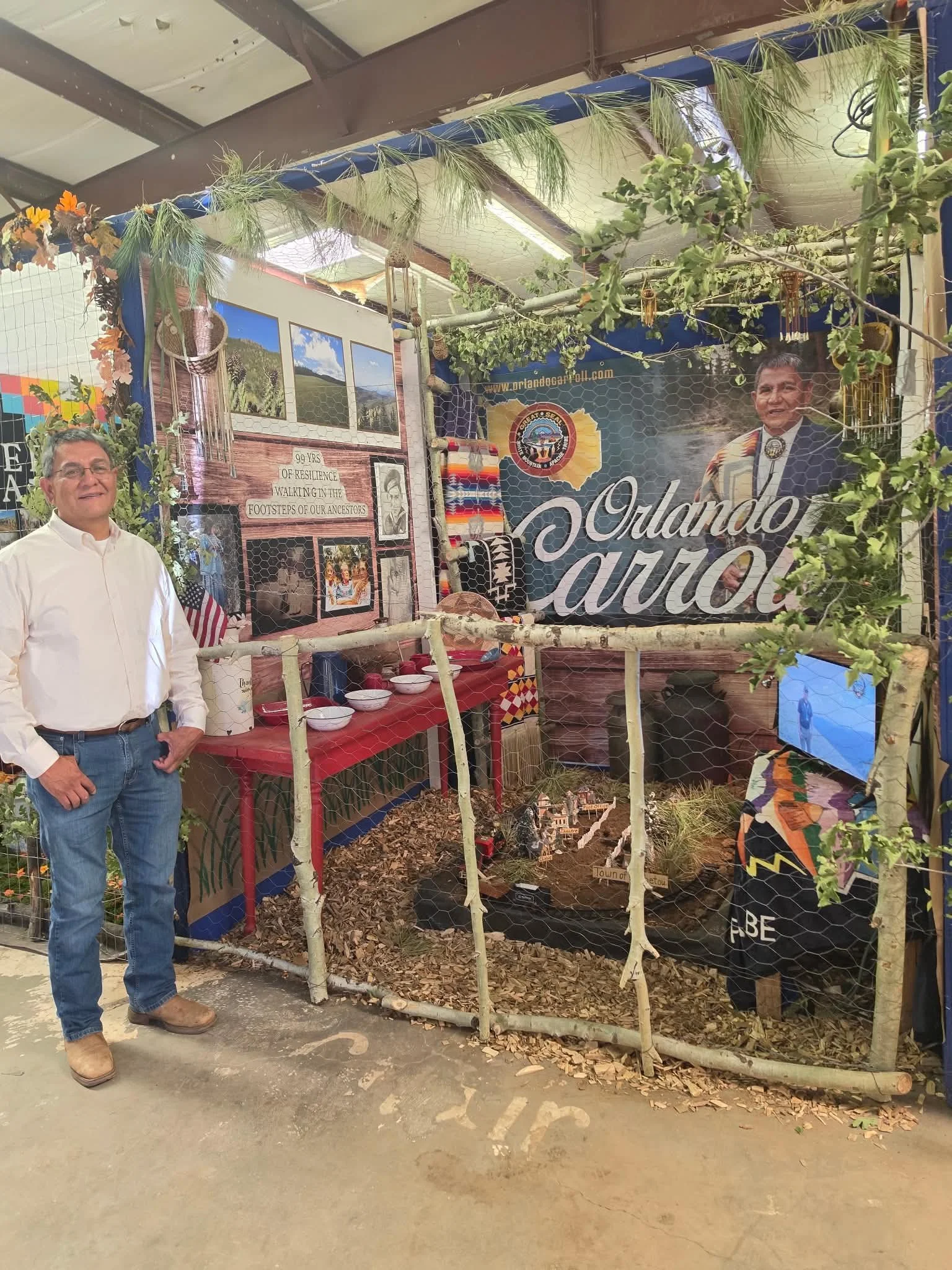
Chairman Carroll standing next to his booth at the Exhibit Hall. The booth included items to help us remember the footsteps of our ancestors, including a timeline, photos of elders from Chairman’s lineage, a scene from Grandmother’s kitchen featuring traditional foods, and a miniature scene of his hometown, McNary, AZ.
Chairman’s Report: Accountability, Service, and the Work Ahead
By Chairman Orlando Carroll
Recently, I received a budget and audit overview from REDW, the firm that completed the Tribe’s most recent audit for fiscal year 2024. The presentation addressed the Tribe’s current financial condition, ongoing compliance concerns, internal control deficiencies, and reforms needed to restore accountability and fiscal stability.
The Tribe is delinquent in submitting its 2025 Single Audit Report, which was due January 31, 2026. Continued delay may expose the Tribe to federal sanctions and place future federal funding at risk. I have called a special Tribal Council meeting so that the full Council can receive the audit findings directly from the auditors, ask questions, and understand the corrective actions that must be taken.
The Single Audit Report reviews the Tribe’s administration of federal, state, and Tribal funding, excluding Tribal enterprises. It also includes compliance testing of major grant-funded programs identified for audit. Because the Tribe’s fiscal year ends April 30, the report must be submitted to the Federal Audit Clearinghouse by January 31 following the fiscal year-end.
The auditors identified repeated internal control deficiencies, including conditions classified as material weaknesses. These conditions increase the risk of errors, fraud, misuse of funds, or transactions not being properly recorded. REDW has provided recommendations to the Tribe, including the need for a stronger segregation of duties so that one person does not control every stage of a financial transaction.
The Tribe must also address findings involving restricted funds. Money awarded for a specific program or service must be used for its authorized purpose. Diverting restricted funds or services undermines accountability, violates funding requirements, and may jeopardize continued federal support for programs our people depend upon.
The Tribe is also facing a deficit that is projected to increase if expenditures continue to exceed revenues. The 2025 financial outlook will depend upon resolving legacy balances and adopting structural reforms that ensure the Tribe’s ongoing expenses do not exceed its available revenue. Balancing the budget will require accurate and current financial information, qualified professional advice, responsible decisions, and cooperation between the Executive Office and Tribal Council.
There are governance options available to strengthen financial oversight. Some may require amendments to Tribal ordinances and meaningful consultation with the public. Audit requests should come through the Tribal Council rather than from individual staff members. This will create an official record, establish responsibility, and ensure that audit oversight remains an institutional duty.
Based on the information provided to my office, the 2023 audit report was not presented to the incoming Tribal Council, even while matters involving Tribal finances were under review. We understand that no full Council briefing occurred. The Council should have access to critical financial information necessary to carry out its responsibilities. The special meeting with REDW is intended to ensure that the governing body receives the information directly and can begin addressing the findings together.
Our people also have an important role. The community must continue to hold its elected leadership accountable for overspending and the use of public funds. As a Tribe, we cannot correct the deficit or plan responsibly without an honest understanding of our present financial condition. My commitment is to use current information, professional guidance, and appropriate oversight to work toward a balanced and sustainable budget.
On August 27, the Executive Office held its first Town Hall Meeting at the Whiteriver American Legion. We were encouraged by the strong turnout and grateful to everyone who attended, asked questions, and shared concerns about the future of our Tribe.
The purpose of the Town Hall was to provide information directly to the community, listen to the people, and begin building a stronger relationship between Tribal members and their government. We received important questions, constructive criticism, and recommendations that will help guide our work. Questions that could not be addressed during the meeting are being reviewed, particularly when participants provided contact information for follow-up.
The Community Priorities Survey was conducted in connection with this effort. Between August 23 and September 5, 2026, 189 people completed the survey. Housing was the most frequently selected concern, chosen by 123 respondents, or 65.1 percent. Jobs and financial well-being followed with 105 responses, or 55.6 percent. Water was selected by 86 respondents, or 45.5 percent, and drug and alcohol prevention was selected by 81 respondents, or 42.9 percent.
Public safety and security and language and culture were each selected by 59 respondents. Other frequently identified priorities included transparency and communication, education, youth programs, government accountability, elder services, roads and infrastructure, and natural resources.
The written responses gave us a clearer understanding of what these priorities mean in people’s daily lives. Community members described overcrowded homes, long housing waiting lists, homelessness, limited employment, low wages, water outages, road conditions, substance use, bootlegging, youth safety, and the need for stronger accountability within Tribal government.
Many participants also recognized the administration’s efforts to listen through surveys, town halls, outreach, and improved communication. A total of 144 respondents, or 76.2 percent, indicated that they would like to receive continued updates from the Chairman’s Office.
These findings reflect the views of the 189 people who voluntarily participated. They should not be interpreted as representing the opinion of every Tribal member. Responses were anonymous, more than half came from District IV, and the survey did not use random sampling, collect demographic information, or independently verify one response per person. Even with these limitations, the survey provides meaningful guidance about the concerns raised by participating community members.
The Town Hall and survey were the beginning of an ongoing process. During the coming quarter, the Executive Office will share the findings with the departments and Tribal entities responsible for the identified issues. We will request information about the work already underway, immediate actions that can be completed, barriers preventing progress, and projects that require additional funding or Tribal Council action.
Some concerns, including major housing development, water infrastructure, and new community facilities, will require long-term planning and significant funding. Other actions, such as improving communication, documenting needs, coordinating departments, clarifying service processes, and preparing projects for funding opportunities, can begin now.
Our next quarterly Town Hall Meeting is planned for Cibecue in November. At that meeting, we intend to report back on the community’s leading priorities, the actions taken during the quarter, the challenges encountered, and the work that remains ahead.
Community members are encouraged to review the accompanying “Townhall Meeting: Community Priorities” one-page summary for a visual overview of the survey results, what participants told us, and the next steps being taken by the Executive Office of Chairman Orlando Carroll.
The 99th Annual White Mountain Apache Tribal Fair and Rodeo was successful, and I am grateful for the dedication of the Fair Commission, staff, volunteers, departments, vendors, contestants, and community members who helped make it possible.
There were financial limitations this year, and the community may have noticed differences in the Night Performance. In prior years, the Night Performance did not operate under a clearly defined budget. Those organizing it were able to spend hundreds of thousands of dollars on multiple performers, food, lodging, and related expenses. That level of spending made it possible to bring numerous acts to the Fair, but it was not financially sustainable.
This year, the Fair Commission had to work within the resources available. There was no unlimited budget. The Commission did the best it could under those circumstances, and we commend its members for producing a successful celebration while working within financial limitations.
We must now begin planning for the 100th Annual Tribal Fair and Rodeo. This will be an important milestone for the White Mountain Apache Tribe, and preparations should begin as soon as possible. The Tribal Council will begin considering potential commissioners and the selection of a new Fair Manager. Early planning will allow us to establish a responsible budget, secure performers and vendors, pursue sponsorships, and create a celebration worthy of the Fair’s 100-year history.
The annual Trophy Elk Hunt is currently underway. Tribal Council members were invited to attend the hunters’ dinner. Unfortunately, no Council member was able to attend because the event occurred during the demanding schedule surrounding Fair week. We appreciate everyone involved in hosting the hunt and welcoming its participants to our homeland.
I extend my appreciation to the Tribal Utility Authority for responding quickly to the major water-main break affecting Whiteriver. TUA employees worked continuously to complete the repair, restore the system, and distribute water to Tribal members affected by the outage.
Once I became aware of the seriousness of the situation, I notified all Tribal Council members that efforts to obtain donated water had begun. I contacted Councilman Clay and Tribal Treasurer Deron Peaches and asked them to assist with securing water for the community.
Councilman Clay secured two truckloads of donated water from Walmart. The Office of the Chairman also secured one truckload from Bashas’. We are grateful to these businesses and to everyone who helped transport and distribute water. This response demonstrated what can be accomplished when Tribal leadership, departments, businesses, and community members work together during an emergency.
The White Mountain Apache Tribe will observe Native American Day on Friday, September 25, 2026. This day honors the enduring histories, cultures, knowledge, and contributions of Native nations. For our people, it is also a time to recognize the strength of our ancestors and our responsibility to protect our Apache identity, language, land, water, and lifeways for future generations.
The Office of the Chairman continues to receive requests for assistance with rent, utility bills, and other personal expenses. We understand that many families are experiencing financial hardship. However, the Office of the Chairman does not have a program or funding source that allows it to pay individual household bills or rent.
Members of the Tribal Council have been informed about the types of expenses the Tribe can and cannot pay. Personal bills are among the expenses the Tribe is not currently authorized or funded to cover.
Requests for home renovations or improvements must first be submitted to the White Mountain Apache Housing Authority. The Chairman’s Office does not currently have funding available for individual home repairs or renovations. We will continue working with departments and funding partners to identify grants and other opportunities that may help address the Tribe’s broader housing and home-repair needs.
The work before us requires honesty, discipline, cooperation, and accountability. We must address the Tribe’s financial condition, strengthen internal controls, protect restricted funding, and make decisions based on complete and current information. At the same time, we must continue responding to immediate community needs, planning responsibly for major events, and communicating openly with the people.
These challenges will not be resolved overnight. My administration will continue gathering the facts, bringing critical information before the Tribal Council, and working toward reforms that protect the Tribe’s resources and strengthen our government for future generations.
May God continue to guide, protect, and strengthen our Apache people as we work together for the wellbeing of our Tribe and future generations.
Ft. Apache Scout Article, 8/21/2026
Chairman’s Report
As we continue the work of moving our Tribe forward, I want to keep our people informed about the work taking place within Tribal government, the progress we are making, and some of the important matters before the Tribal Council.
My staff is currently preparing for our first Town Hall Meeting on Thursday, August 27, at 5:30 p.m. at the Whiteriver American Legion. We have been gathering updates from our Tribal departments so that we can provide tribal members with an overall picture of the Tribe, where we stand today, and what has been accomplished since this administration took office on May 6.
I appreciate the department heads who have provided their information. This Town Hall is an opportunity for our people to hear directly about the work happening throughout Tribal government and the issues we still need to address. I encourage our Tribal members to attend.
One of my priorities is improving the way our Tribal government operates. The Office of the Chairman has been working with the Treasurer, Information Technology, Human Resources, and Payroll to begin using ADP more fully.
Employees are asked to set up their ADP accounts so they can request leave and access their pay stubs electronically. Beginning August 23, employees will submit all leave requests through ADP instead of using paper forms. This first step will help employees and supervisors learn how to use the system before more features are added. The next phase is planned for September 20, when employees will begin clocking in and out through ADP.
Our goal is to reduce paperwork, improve access to information, make our processes more efficient, and make better use of technology the Tribe already has.
My office recently participated in the AHCCCS Tribal Consultation, where Tribal representatives received updates and discussed issues affecting healthcare throughout Arizona Indian Country. Topics included AHCCCS and federal updates, the Rural Health Transformation Program, H.R. 1, public health preparedness, and the Arizona Health Improvement Plan. AHCCCS conducts these consultations with Tribes, IHS, tribally operated health programs, and urban Indian health organizations regarding policies and programs that may significantly affect tribal members.
While there, we also had an opportunity to connect with healthcare administrators from the San Carlos Apache Tribe and learn from their experience pursuing greater Tribal control over healthcare. San Carlos began formally preparing for IHS self-governance years ago, including receiving an IHS planning award.
Their journey is important for us to study. Under IHS self-governance, Tribes can assume federal healthcare programs and funding and manage those resources according to the needs and priorities of their own communities. I believe we should learn from Tribes that have taken greater responsibility for their healthcare systems and carefully consider what opportunities may exist for the White Mountain Apache Tribe. Ultimately, our goal should be a stronger healthcare system that responds to the needs of our people.
I had the privilege of welcoming participants to the Men’s Health & Wellness Conference. Events like this are especially important in our community because our men carry tremendous responsibilities within their families and our Tribe. We must continue encouraging our men to take care of their physical, mental and emotional well-being and to know that seeking support is a sign of strength.
The Tribal Council recently met with Arizona Attorney General Kris Mayes, who visited Whiteriver to meet with Tribal leadership. She also took time to visit with our Youth Council. These relationships are important. We want state and federal leaders to understand our community, hear directly from our people, and recognize the issues and priorities of the White Mountain Apache Tribe.
The Tribal Council worked diligently over several weeks to review the Tribe’s boards and consider the best appointments moving forward. This was a tremendous effort, as we also considered different possibilities for several Tribal departments. We worked to provide more Tribal members with the opportunity to serve by ensuring that no individual serves on more than one board. We also established four new boards: Education, Apache Enterprise, Game & Fish, and a board that oversees the combined Public Works, Utility, and Land Operations.
As we do this work, I continue to encourage the Council to focus on making professional, informed decisions for the good of the Tribe. The decisions we make should never be about any one individual Council member; they must be about what is best for the White Mountain Apache people.
Part of good governance is also being prepared. Whenever possible, agenda items, motions and supporting information should be provided to Council members beforehand. Proper notice gives Council members time to understand an issue, ask questions and make informed decisions. Surprise motions or major decisions presented without adequate information make productive deliberation more difficult. I want us to continue strengthening our procedures so our government operates professionally and responsibly.
The Council has also interviewed several candidates for Hon-Dah General Manager. We are narrowing the selection and continuing both virtual and in-person interviews.
We are also continuing discussions regarding the Housing Authority. There is still work to be done, but our goal is straightforward: improve the situation and ensure that housing services better meet the needs of our people.
Last week, I had the privilege of attending the retirement luncheon honoring Chief of Police Steven Kane for 44 years of service.
It was important to me that our Tribe formally acknowledge Chief Kane and thank him for the decades he dedicated to our people. Forty-four years of public service also represents years of sacrifice by his family, who shared him with our community.
My office presented Chief Kane with a special Chairman’s Appreciation Plaque and a blanket designed by an Osage Tribal artist as a small expression of our gratitude. I want Chief Kane and his family to know that their sacrifice and service are appreciated by the White Mountain Apache Tribe.
The Tribal Council recently received an update from the Tribal Fair & Rodeo, and most of the major plans are now in place.
With thousands of people expected to visit our community, I am asking all Tribal departments to help us prepare Whiteriver and our surrounding areas. This is our home, and the Fair is an opportunity to welcome visitors and show pride in our community.
The Fair Parade will be Saturday, September 5. Road closures are expected to begin at approximately 6:30 a.m. at Highway 73 and River Road, with traffic rerouted onto River Road. N. Tenijieth and Mulberry Street will be used for parade lineup traffic, with float lineup beginning at N. Cosen Street.
Please do not block streets leading into residential areas. Emergency vehicles must continue to have access before, during and after the parade. Officers will be stationed at key locations, and parade routes and detours will be posted on social media as we get closer to the Fair.
I ask everyone to please respect our WMAT Police Officers and visiting law enforcement officers who will be working these events. They are there to protect our community and help everyone enjoy the Fair safely.
As our students return to school, I am asking parents to pay particular attention to young drivers. Law enforcement has received concerns regarding students driving to school without the appropriate driver's license, school permit or vehicle insurance.
Parents have a responsibility to make sure their children are legally authorized to drive before allowing them to take a vehicle. Parents may be cited for allowing an unauthorized or unlicensed driver to operate a vehicle.
I also ask everyone to slow down and watch for students and other pedestrians. Highway 73 between Hon-Dah and Whiteriver is not a freeway. Give yourself enough time to get where you are going and help us keep our children and community safe.
Our law enforcement officers, detectives, WMAT Rangers and outside search-and-rescue partners have continued efforts to locate Murphy Malone, an adult male who has been reported missing.
On August 10, search teams covered areas throughout Whiteriver using foot searches, UTVs and ATVs. Game Rangers also deployed a drone in the canyon area from the FATCO Bridge to the Baptist Church. On August 11, Navajo County Search & Rescue assisted, including searches from the Fort Apache Bridge toward the Whiteriver Hospital and horseback search efforts. On August 13, WMAT Detectives Cantu and Carrillo traveled to the Phoenix area and checked homeless shelters and hospitals, but Mr. Malone was not located.
Anyone with information that may assist in locating Murphy Malone is asked to contact the WMAT Dispatch Center at (928) 338-4942.
There is a great deal happening throughout our Tribal government, and there is much more work ahead of us. Not every issue can be solved immediately, but I believe we can make meaningful progress by improving our systems, expecting accountability, communicating with our people, and keeping our decisions centered on what benefits the Tribe as a whole.
I look forward to sharing more with you at our Town Hall Meeting on August 27. I encourage our people to come, listen, ask questions and learn more about where our Tribe stands today.
May God continue to bless and protect the White Mountain Apache Tribe.
Orlando Carroll
Chairman
White Mountain Apache Tribe
Ft. Apache Scout Article, 7/24/2026
Chairman’s Report
First, I would like to extend my heartfelt condolences to all of the families in our community who have recently lost a loved one. During times of loss, we are reminded of the strength of our families, our traditions, and the compassion that makes the White Mountain Apache people so resilient. My prayers are with each of you as you grieve and honor your loved ones.
I also want to personally thank everyone who reached out to my family following the passing of my mother-in-law, Laura Tsosie. Your prayers, kind words, donations, and support meant more than I can express. Laura was a talented rug weaver, a devoted mother, grandmother, and great-grandmother who deeply loved her family. On behalf of the Tsosie family, thank you for standing with us during this difficult time.
I want to remind the public that free-use wood permits will begin on August 1. As monsoon season continues, please use caution while gathering wood and remain aware of changing weather conditions. We are also evaluating current moisture levels and the possibility of lifting Stage 2 Fire Restrictions when conditions safely allow.
Public safety remains a priority. We are developing a plan to address hazardous trees along Highway 73 before the Tribal Fair, and Tribal Council will soon begin strategic planning sessions with our department directors to identify priorities and strengthen tribal government.
Our administration has now been in office for a little over two months. During that time, much of our work has focused on building the foundation necessary for long-term success.
Strong government begins with understanding our departments, evaluating our current operations, organizing our finances, and creating systems that support better decision-making. I have spent countless hours meeting with department directors, managers, employees, tribal members, and outside partners because I believe listening comes before leading.
Before making changes, I want to understand what is working, what is not working, and what our employees and community members believe can be improved.
One of the important actions recently taken by Tribal Council was the appointment of Mykael Lupe as our Tribe's new Controller.
This appointment makes me proud because Mykael represents what is possible for our young people. He grew up here in Whiteriver, began his education here, excelled in academics and athletics, and went on to earn his Bachelor's Degree in Business Economics, graduating Summa Cum Laude, along with his Master of Business Administration with distinction from Northern Arizona University in just four years. He is also pursuing his Certified Managerial Accounting certification through Arizona State University.
Throughout his life, he has remained connected to our community through youth programs, Apache ceremonies, and service to our people. He has always spoken with gratitude about the teachers and coaches who challenged him to pursue excellence, including Coach Bob London, the late Coach Frank Girardi, Mrs. Jennifer Abril, and Mrs. Pauline Endfield.
I am pleased to welcome a talented tribal member home to help serve our people.
Many people may not realize how important the Controller position is to tribal government.
The Controller oversees accounting, financial reporting, internal controls, grant compliance, audits, and budget management. This position helps ensure that our finances are organized, our reporting is accurate, and our resources are protected.
One of my highest priorities since taking office has been improving the Tribe's budgeting process and strengthening our financial management. Bringing qualified leadership into this position is an important step toward achieving that goal.
Financial accountability remains one of my administration's highest priorities.
The Tribe continues working to complete its outstanding Single Audit Report for numerous contract and grant-funded programs. Completing this work is critical to maintaining compliance with funding requirements, protecting future funding opportunities, and demonstrating responsible stewardship of tribal resources.
I appreciate the work being done by the Treasurer's Office, and I encourage everyone involved to continue pushing this effort forward. Accountability belongs to all of us. Directors, managers, program staff, and leadership all share the responsibility of ensuring reports are completed accurately and on time.
When we protect tribal resources, we protect opportunities for future generations.
I continue meeting with departments across tribal government because I believe the people doing the work every day often have the best ideas for improvement.
These meetings allow employees to discuss challenges, identify barriers, and share solutions that can improve services for our community.
One issue that has been brought to my attention involves ongoing equipment and safety concerns within our Solid Waste Department. Tribal Council is aware of these challenges, and we will continue working toward long-term solutions that improve safety and reliability for both employees and the community.
Another important initiative we are working on is modernizing the way tribal government operates.
Many of our daily processes still rely heavily on paper forms, paper files, manual approvals, and outdated systems. While these methods have served us for many years, technology now gives us opportunities to work more efficiently.
My goal is to give our employees better tools so they can spend more time serving our people and less time managing paperwork. In the coming months, we will begin sharing more information about electronic records, digital workflows, and other modernization efforts that will improve accountability and customer service.
One message I have heard consistently from employees is that many have experienced unhealthy work environments in the past.
People have shared that they were afraid to ask questions, afraid to report concerns, or afraid of retaliation. I want every employee to know that fear should never be the foundation of tribal government.
I believe healthy workplaces are built on respect, fairness, professionalism, accountability, teamwork, and open communication. Policies should apply equally to everyone. Leaders should listen before making decisions, and employees should feel comfortable bringing forward concerns without fear of retaliation.
I do not make decisions based on rumors or emotions. I prefer to hear all sides of an issue, review the facts carefully, and make decisions that are fair and consistent. That is how trust is built.
If you witness misuse of tribal resources, violations of policy, or abuse of authority, I encourage you to report those concerns through the appropriate channels. Transparency, honesty, and accountability protect our employees, our government, and future generations.
Recently, the White Mountain Apache Tribe had the honor of hosting more than thirty tribal leaders from across Arizona.
This gathering gave us an opportunity to strengthen relationships with other tribal governments while showcasing the beauty of our reservation. Many of our guests visited Sunrise Park Resort and experienced the summer activities available there.
I hope they return to their communities with positive experiences to share and encourage others to visit the White Mountain Apache Reservation. Building strong relationships throughout Indian Country helps strengthen our voice and creates new opportunities for collaboration.
I often remind myself and those around me that every decision we make today affects future generations.
Meaningful change takes time, but I believe we are moving in the right direction. Every meeting, every improvement to our processes, every conversation with our employees, and every effort to strengthen accountability brings us closer to the kind of government our people deserve.
It is an honor to serve as your Chairman. Thank you to our elders for your wisdom, our veterans for your service, our teachers, healthcare workers, first responders, tribal employees, volunteers, and every community member who contributes to making the White Mountain Apache Tribe stronger.
Together, we will continue building a brighter future for our people.
Ft. Apache Scout Article, 6/12/2026
Strengthening Accountability, Enhancing Operations, and Securing Our Tribe’s Future
As we move forward into the summer season, the Chairman's Office remains deeply committed to building a stronger, more resilient future for our White Mountain Apache Tribe. Leadership requires continuous engagement, fiscal responsibility, and respect for the people and resources that keep our nation running. Today, I want to share several key updates regarding our tribal budget management, professional development for staff, critical water rights advocacy, and a special moment of community recognition.
To ensure our tribe remains on solid financial footing, the Chairman's Office is working hand-in-hand with all tribal departments to implement oversight on internal spending. Our goal is simple: transparency and efficiency. We are actively issuing budget advisories and conducting comprehensive reviews with department heads. We are requesting justification and additional information for reimbursement requests. Every program is being asked to carefully evaluate its expenditures across four core areas:
Budgets: Aligning actual spending with approved allocations and following fiscal policies and procedures.
Personnel Costs: Ensuring staffing levels are optimized and financially sustainable.
Supplies & Equipment: Streamlining procurement to eliminate waste.
Travel: Authorizing trips that are built into the budget.
By standardizing these reviews through the Chairman’s Office, we will ensure that every department operates proficiently. More importantly, this process allows us to know exactly where each department stands, giving us an accurate picture of our spending as a tribe.
A proficient government relies on a well-equipped workforce. We are currently rolling out comprehensive updates and training sessions to ensure all tribal staff members are thoroughly versed in our official standards and procedures.
Special emphasis is being placed on the Code of Ethics, Leave Policies, and Accountability for both employees and the Chain of Command. The Code of Ethics is to ensure the upholding of the highest levels of integrity and public trust. The Leave Policy has clarifying expectations for time off to ensure fair, consistent enforcement.
The Chain of Command across all departments is to reinforce standard reporting structures to streamline communication and resolve issues effectively. Through empowering our employees with a clear understanding of these policies, we protect both our workers and the tribal operations they support.
Securing and protecting our natural resources is one of the most critical responsibilities we hold for future generations. Recently, leadership held a meeting with our federal legal lobbyists at the Hon-Dah Resort to discuss the ongoing protection of the tribe's water rights. We reviewed current legislative landscapes and mapped out the next steps for defending our water sovereignty in Washington, D.C. Water is life, and we will continue to protect and ensuring our Tribal rights are respected.
Finally, June 12th marks Women Veterans Day across the nation. On behalf of the entire Chairman’s Office, I want to extend our deepest gratitude, respect, and recognition to all of our White Mountain Apache Women Veterans.
Our sister, mother, and daughter warriors have stepped up throughout history to defend both our tribal lands and the United States, often overcoming unique challenges to do so. Your courage, sacrifice, and continued leadership within our community do not go unnoticed. In a historic milestone for our tribe, this year the Miss White Mountain Apache Queen Priya Simpson serves as our very First Veteran Queen.
"To our Women Veterans: Thank you for your selfless service, your bravery, and your unwavering commitment to protecting our people. You are the pride of our nation."
Moving Forward Together: An Update from the Carroll Administration Following the First Tribal Council Meeting
Posted: Friday, May 15, 2026 5:07 PMThis week, the White Mountain Apache Tribe held its first official Tribal Council meeting under the Carroll/Paxson Administration. We had a productive meeting and are committed to working together respectfully, organized, and unified as we move forward serving the People.
As we strengthen tribal operations and governance, the Council discussed the importance of following proper rules of order and procedures during council meetings to ensure accountability, clarity, and consistency in decision-making.
Council also emphasized that official matters conducted in the name of the White Mountain Apache Tribe must be directed through the authority of the elected Tribal Council, Chairman, and Vice Chairman. Directors and departments play an important role in tribal operations, but decisions, statements, positions, and representations made on behalf of the Tribe should be coordinated through tribal leadership to ensure consistency, accountability, and respect for the authority entrusted to elected officials by the People.
Additionally, executive session matters are confidential and must remain within the executive session. Information discussed during executive session should not be shared, repeated, or discussed outside of council proceedings. Respecting confidentiality is necessary to protect the integrity of tribal government, personnel matters, legal matters, and council operations.
As we transition, the Chairman’s Office recognizes that many systems and processes need to be organized, rebuilt, or improved. I am actively working to strengthen communication, improve responsiveness, and build more efficient, modern systems that make tribal government more accessible and effective for the People, while upholding our Apache values, responsibilities, and commitment to service.
I have also begun meeting with directors and departments, and overall, the meetings have been optimistic and productive. I recognize that many tribal staff are ready to do the work, have innovative ideas, and care deeply about serving the People and improving tribal operations. I will continue meeting with additional directors and departments over the coming weeks, and I appreciate everyone's patience as we work through scheduling and coordination. If we haven't met with your department yet, please know you are important to us. We've logged your messages and will work to connect with everyone as soon as possible.
This work will take time, but we are committed to building stronger systems, improving transparency, and creating a government that works more effectively for our tribal members and employees.
As we head into this weekend, I want to wish everyone a safe and restful time with your families and loved ones. Congratulations again to all of our graduates. We are proud of you and excited for your future!
Thank you again for your patience, support, and prayers as we continue this work together.
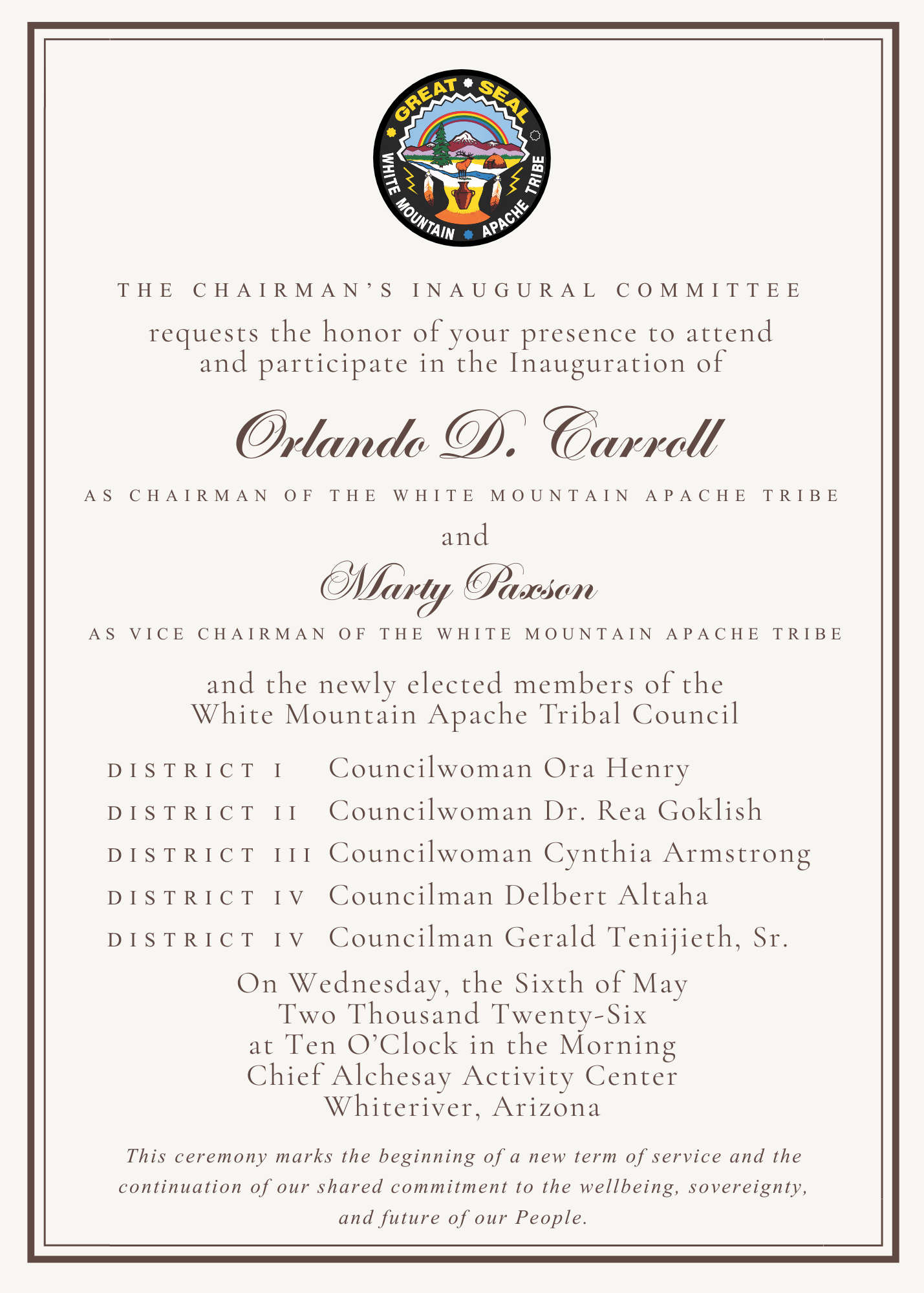
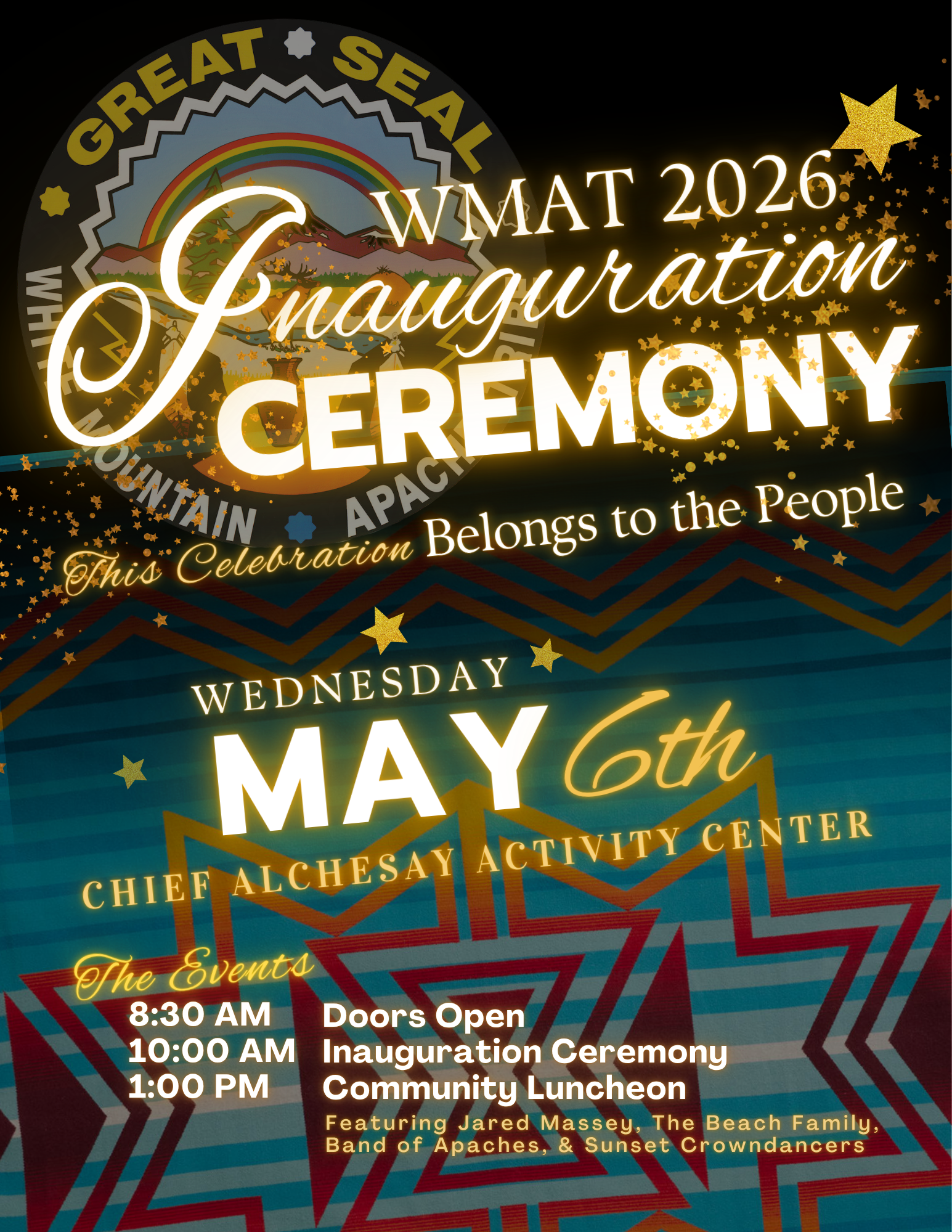
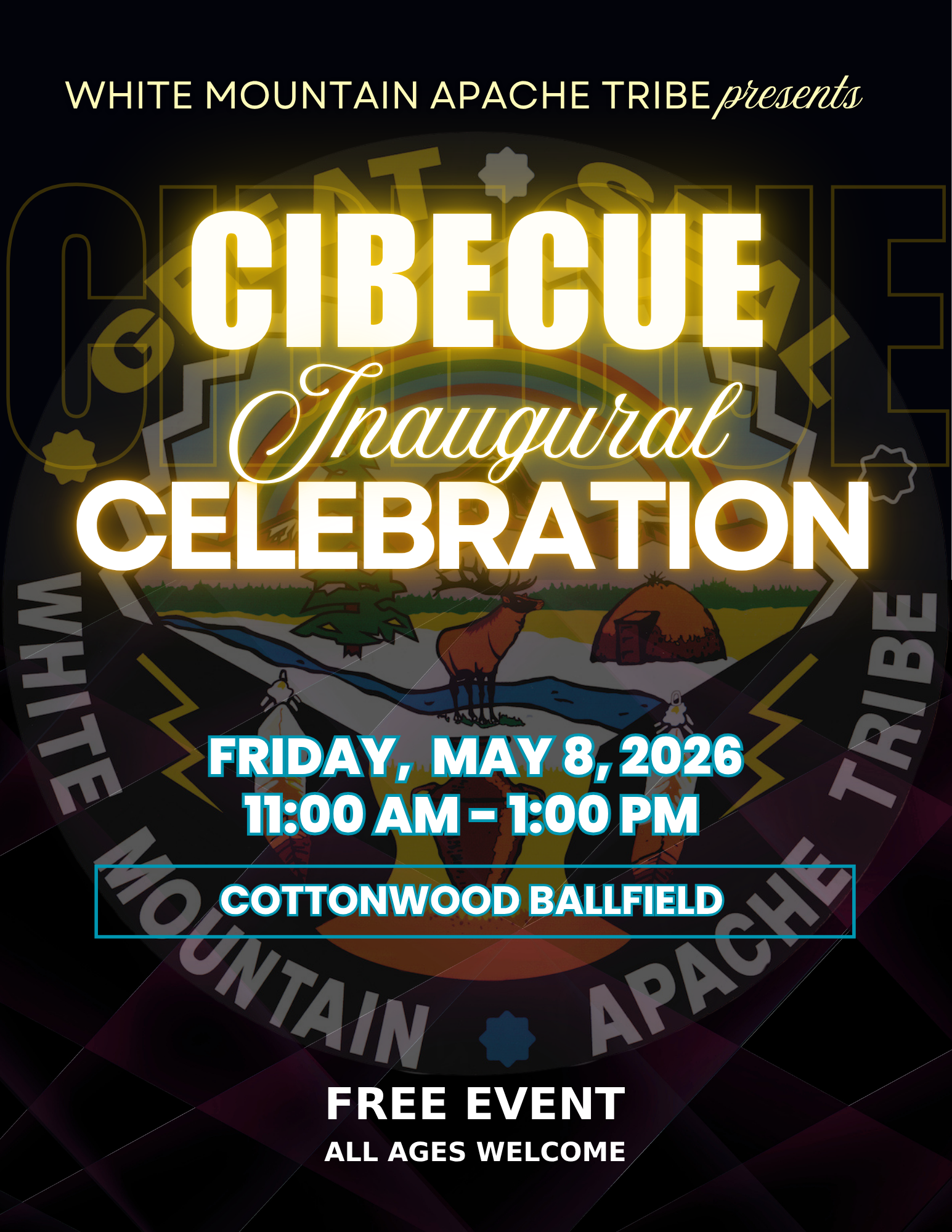
Visit the Calendar page to learn more about all Inauguration Week events



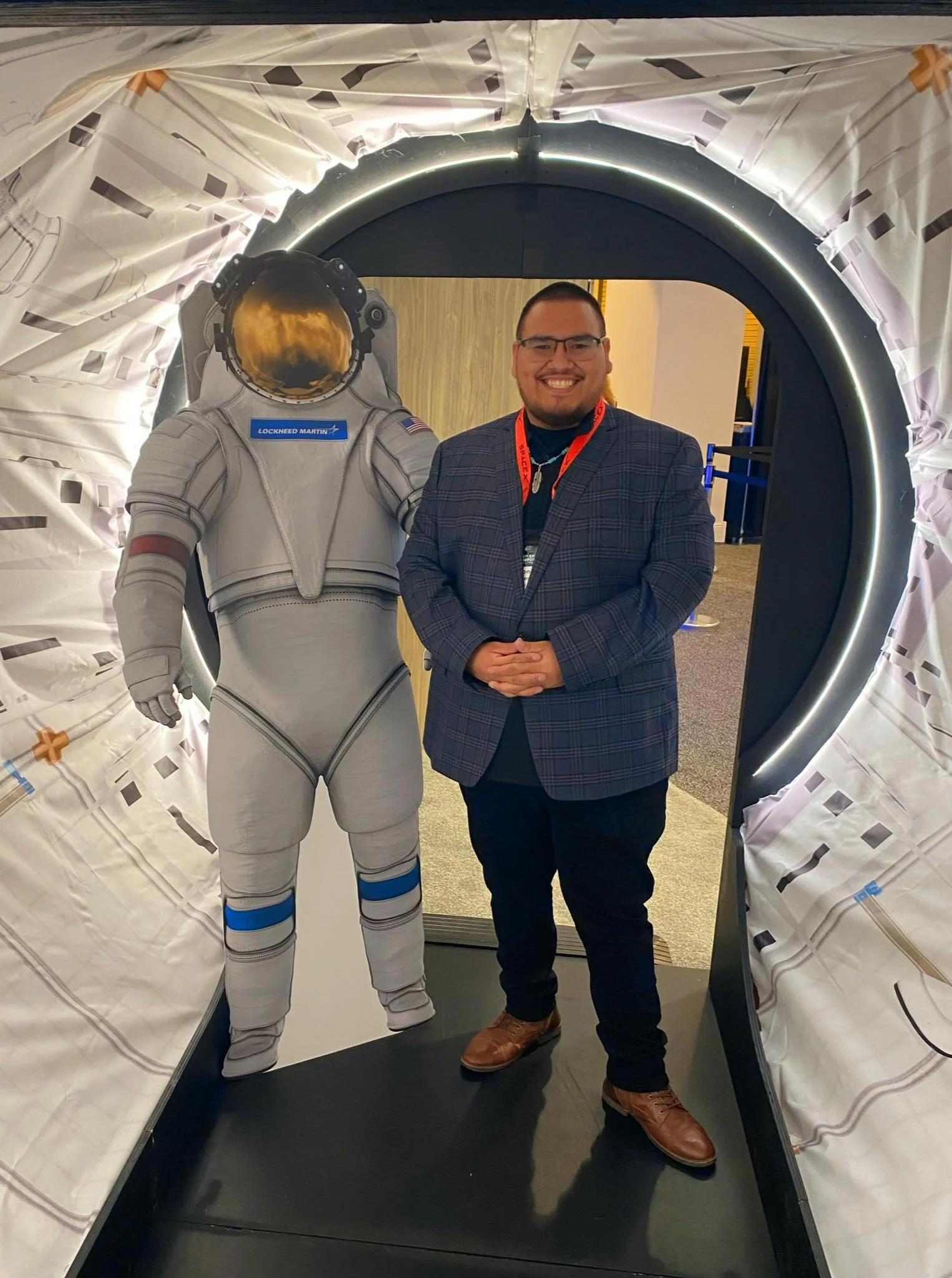
Apache Excellence: From Whiteriver to the Stars
〰️
Apache Excellence: From Whiteriver to the Stars 〰️
Dondre Barker, a proud member of the White Mountain Apache Tribe from Whiteriver, Arizona, is now working with Lockheed Martin Space and helping contribute to the future of space exploration.
Raised by his parents, Russell and Rolanda Barker, Dondre began his journey right here at home—attending Whiteriver Elementary, Canyon Day Junior High, and Alchesay High School. He went on to earn his Associate’s degree from Northland Pioneer College, then continued his education at Fort Lewis College, where he completed his Bachelor’s in Accounting.
His path led him to an internship in Government Relations with Lockheed Martin Space, where he supported major programs, including the Artemis program. Today, he has transitioned from intern to employee, continuing that journey forward.
Now living in Denver, Colorado with his wife, Dovanna Barker, née Dazen, and their son, Drevonn, Dondre says his family inspires him to keep striving for the stars—literally.
Dondre’s story is a reminder to the Apache people: our dreams are within reach. No matter where we start, dedication, education, and belief in ourselves can take us further than we ever imagined.
Honored to Serve as Your WMAT Chairman
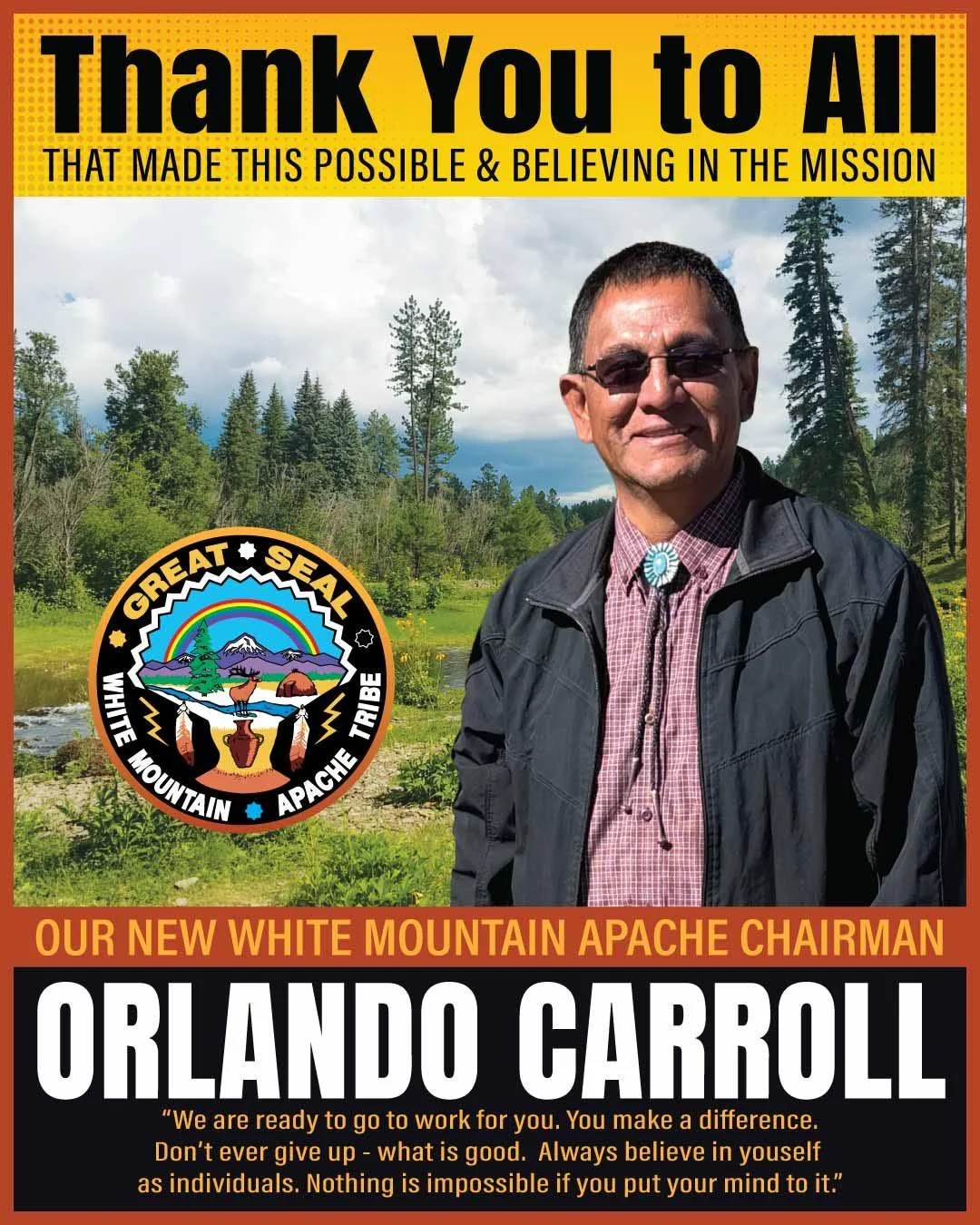
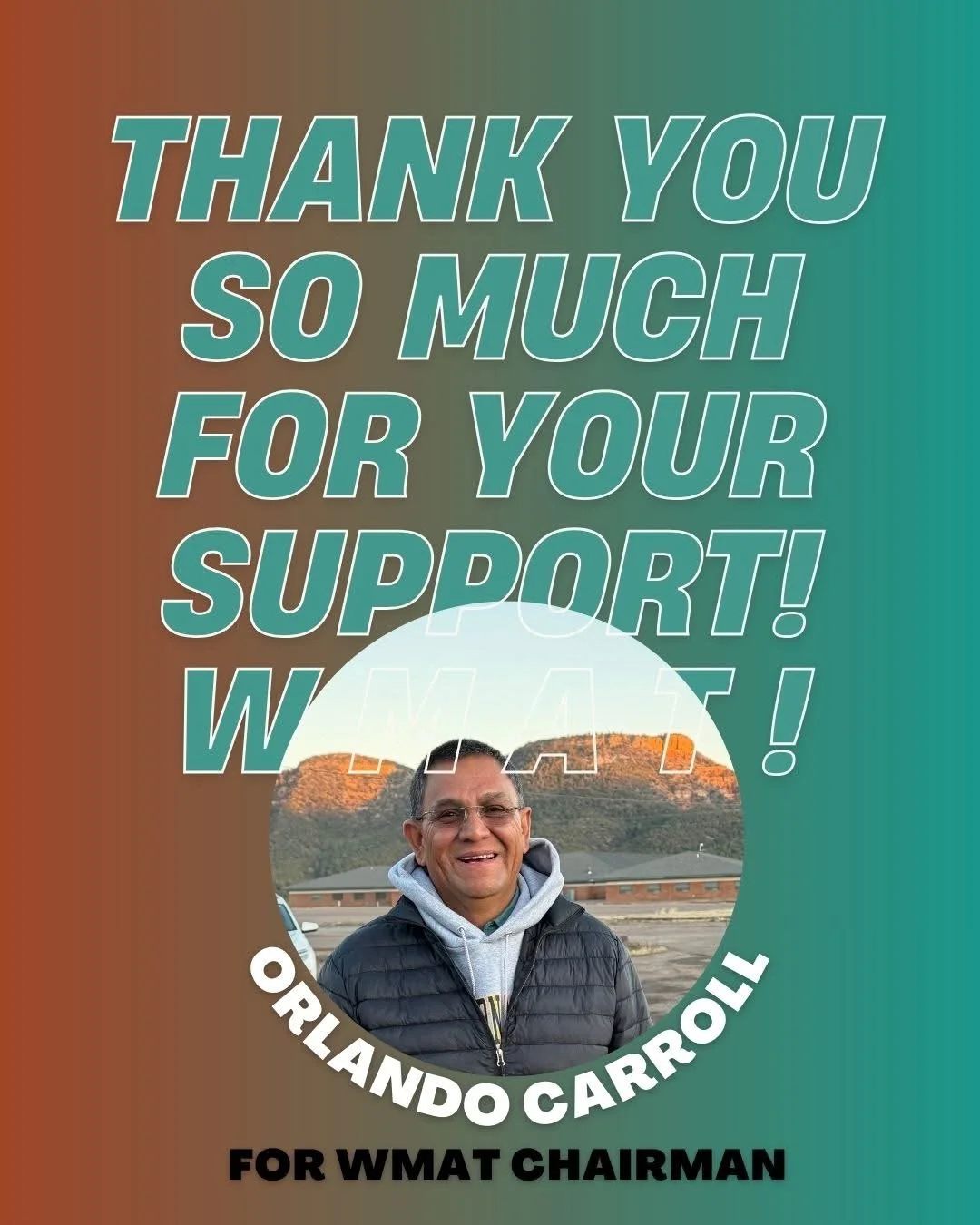
Thank You,
White Mountain Apache Tribe
Team Carroll-Thompson sincerely thanks all tribal members who participated in this election. Your voice reflects the strength of our people and our shared commitment to the future of the White Mountain Apache Tribe.
Congratulations to all candidates who stepped forward to serve our tribe.
A special thank you to Erwin Thompson and his family for their partnership, dedication, and commitment to our people and our future.
We move forward with unity, respect, and hope for brighter days ahead!
Together We Rise
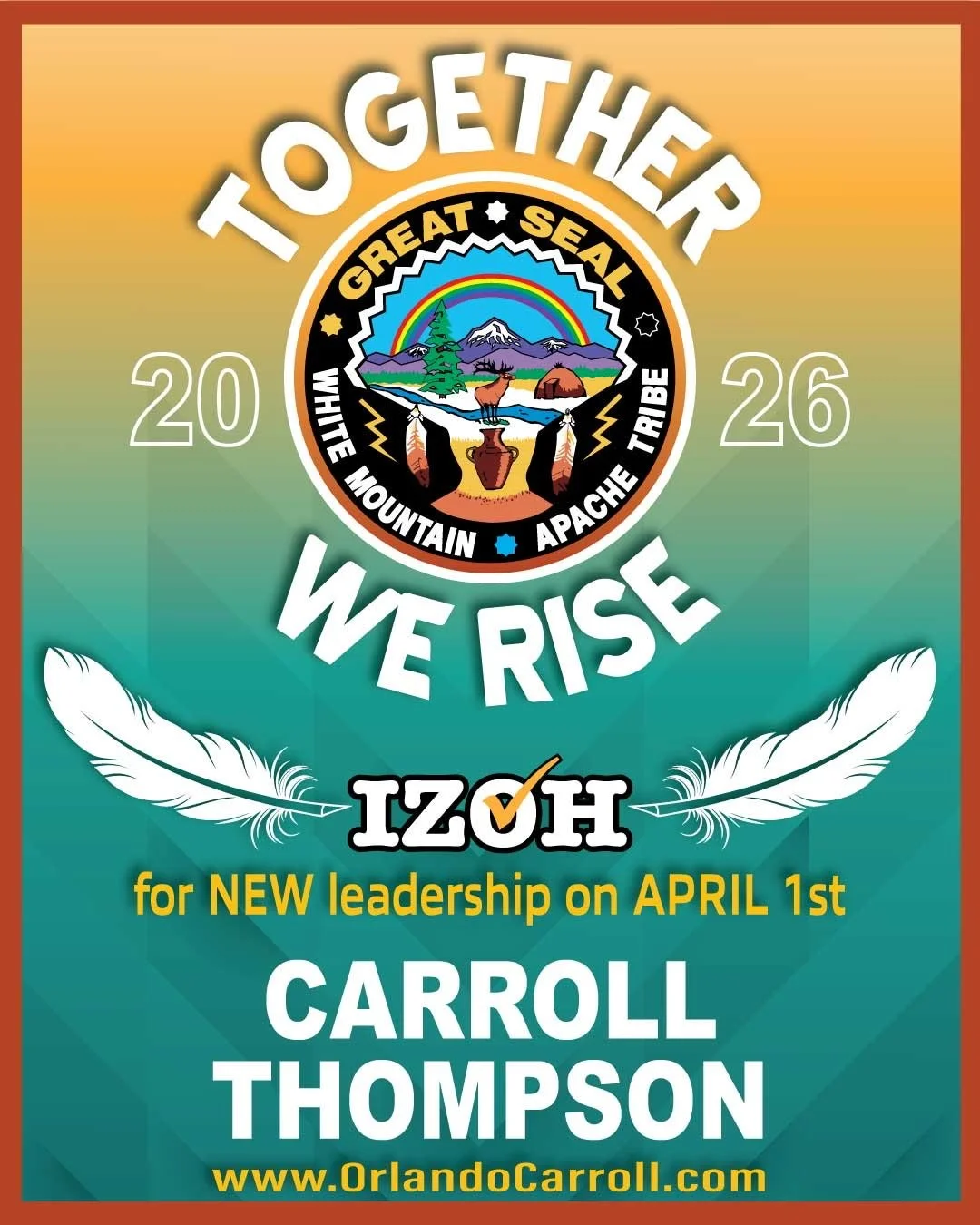
Not all of us had the chance to go to school, finish school, or earn degrees. Many of our people had to work young, raise families, take care of relatives, or survive things others will never understand. Education comes in many forms - life, struggle, responsibility, and survival have taught our people just as much as any classroom.
Our Elders encouraged education because they wanted someone from our own community to be able to sit in those rooms where powerful decisions are made - decisions about our land, our water, our children, and our future. They knew that one day we would need Tribal members who could understand the legal and political systems that outsiders use to take what is ours.
That doesn't mean everyone has to earn a degree.
We all have different paths, and every path has value.
Some protect the Tribe by working hard every day.
Some protect the Tribe by caring for family and community.
Some protect the Tribe by carrying language, songs, and teachings.
And some protect the Tribe by using formal education to fight where the battles are happening.
That is where Orlando Carroll comes in.
His education isn't something he holds above the people. It's something he uses FOR the people. For over 30 years, he has taken what he learned and used it to defend Apache homelands, water, language, and culture. These are things that define us as a Tribe and make us who we are.
Education, whether from life or from school, is meant to lift our people, not divide us. And when one of us rises, all of us rise with them.
This message is for anyone who has ever felt "not good enough," "not smart enough," or unsure of where they fit: YOU MATTER. You are part of this Tribe. You belong in this movement.
There is a place for each and every one of us in the work of protecting our future.
Together, we rise.
Our Vision for a Healthy, Strong, and Thriving Nation

1. Protecting Our Land and Natural Resources
Our land is our identity. Orlando is committed to responsible land use, protecting our water, strengthening conservation efforts, and ensuring that decisions about our homeland always reflect what is best for future generations.
2. Strengthening Families and Community Wellness
A strong tribe begins with strong families. Orlando supports safer neighborhoods, more youth programs, addiction recovery supports, mental health services, and partnerships that uplift our children, elders, veterans, and families.
3. Creating Jobs and Growing the Apache Economy
Orlando believes our people thrive when opportunities grow here at home. His focus includes expanding job training, supporting local entrepreneurs, and building sustainable economic development that benefits our people — not outside corporations.
4. Restoring Apache Lifeways and Cultural Pride
Our language, culture, and ancestral knowledge are the foundation of sovereignty. Orlando will support tribal programs that strengthen Apache identity, teach our youth, and protect the traditions that define us as a nation.
5. Honoring Transparency and Accountability
Our people deserve honesty, clarity, and fairness from leadership. Orlando is committed to restoring trust, improving communication, and ensuring that tribal members’ voices guide every major decision.
Why Orlando Carroll Is the Leader We Need
✔ 30+ years protecting Apache land and resources
✔ A steady, humble, community-centered leader
✔ Experienced in solving problems and building solutions
✔ Committed to listening to families in every community
✔ Guided by Apache values: respect, honesty, generosity, and responsibility to future generations
Orlando brings a lifetime of service, not for personal gain, but because he cares for his people and wants a stronger future for all of us.

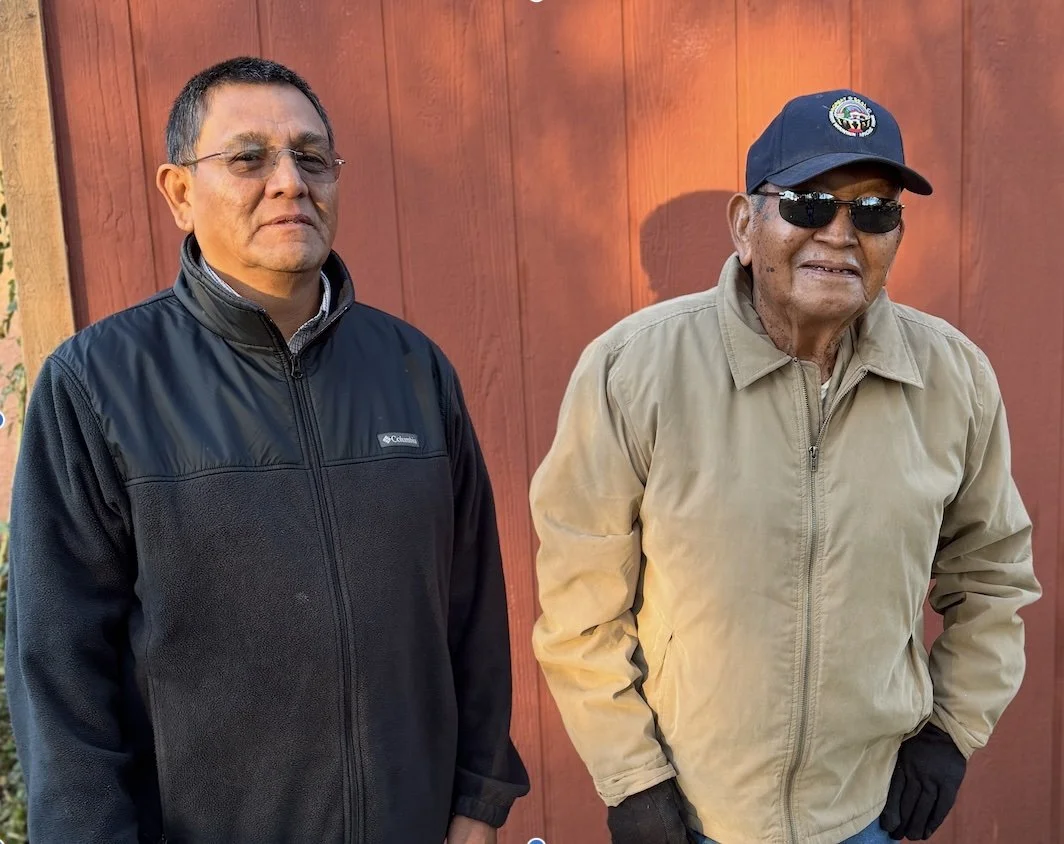
Join the Movement
〰️
Join the Movement 〰️
Together, we can protect our land, strengthen our families, and build a future where every Apache child, elder, and family can thrive.
Sign up. Volunteer. Share your ideas. Your voice matters and it deserves to be heard.
This is our time. This is our home.
Let’s build a better future together.
Follow us on social
Contact Our Team
Have a question or want to get involved? We want to hear from you.
Email: info@orlandocarroll.com
(928) 288-2392
Or use the contact form to send a message.